Carl Neumann
Carl Neumann | |
|---|---|
 | |
| Born | (1832-05-07)7 May 1832 Königsberg, Prussia |
| Died | 27 March 1925(1925-03-27) (aged 92) Leipzig |
| Nationality | German |
| Alma mater | Königsberg University Halle |
| Known for | Dirichlet problem Neumann series |
| Scientific career | |
| Fields | integral equations |
| Institutions | University of Halle-Wittenberg University of Basel University of Tübingen University of Leipzig. |
| Thesis | De problemate quodam mechanico, quod ad primam classem integralium ultraellipticorum revocatur[1] |
| Doctoral advisor | Friedrich Richelot and Otto Hesse |
| Doctoral students | William Edward Story Emil Weyr |
Carl Gottfried Neumann (also Karl; 7 May 1832 – 27 March 1925) was a German mathematician.
Contents
1 Biography
2 Works by Carl Neumann
3 Notes
4 References
Biography
Neumann was born in Königsberg, Prussia, as the son of the mineralogist, physicist and mathematician Franz Ernst Neumann (1798-1895), who was professor of mineralogy and physics at Königsberg University. Carl Neumann studied in Königsberg and Halle and was a professor at the universities of Halle, Basel, Tübingen, and Leipzig.
While in Königsberg, he studied physics with his father, and later as a working mathematician, dealt almost exclusively with problems arising from physics. Stimulated by Bernhard Riemann's work on electrodynamics, Neumann developed a theory founded on the finite propagation of electrodynamic actions, which interested Wilhelm Eduard Weber and Rudolf Clausius into striking up a correspondence with him. Weber described Neumann's professorship at Leipzig as for "higher mechanics, which essentially encompasses mathematical physics," and his lectures did so.[2]Maxwell makes reference to the electrodynamic theory developed by Weber and Neumann in the Introduction to A Dynamical Theory of the Electromagnetic Field (1864).
Neumann worked on the Dirichlet principle, and can be considered one of the initiators of the theory of integral equations. The Neumann series, which is analogous to the geometric series
- 11−x=1+x+x2+⋯displaystyle frac 11-x=1+x+x^2+cdots
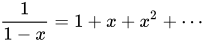
but for infinite matrices, is named after him.
Together with Alfred Clebsch Neumann founded the mathematical research journal Mathematische Annalen. He died in Leipzig.
The Neumann boundary condition for certain types of ordinary and partial differential equations is named after him (Cheng and Cheng, 2005).

Carl Gottfried Neumann, 1912
Works by Carl Neumann
Das Dirichlet'sche Princip in seiner Anwendung auf die Riemann'schen Flächen (B. G. Teubner, Leipzig, 1865)
Vorlesungen über Riemann's Theorie der Abel'schen Integrale (B. G. Teubner, 1865)
Theorie der Bessel'schen functionen: ein analogon zur theorie der Kugelfunctionen (B. G. Teubner, 1867)
Untersuchungen über das Logarithmische und Newton'sche potential (B. G. Teubner, 1877)
Allgemeine Untersuchungen über das Newton'sche Princip der Fernwirkungen, mit besonderer Rücksicht auf die elektrischen Wirkungen (B. G. Teubner, 1896)
Über die Methode des arithmetischen Mittels (S. Hirzel, Leipzig, 1887)
Die elektrischen Kräfte (Teubner, 1873-1898)
Notes
^ Carl Neumann at the Mathematics Genealogy Project
^ Christa Jungnickel, Russell McCormmach, Intellectual Mastery of Nature. Theoretical Physics from Ohm to Einstein (1990) Vol. 1. p. 181.
References
O'Connor, John J.; Robertson, Edmund F., "Carl Neumann", MacTutor History of Mathematics archive, University of St Andrews.mw-parser-output cite.citationfont-style:inherit.mw-parser-output qquotes:"""""""'""'".mw-parser-output code.cs1-codecolor:inherit;background:inherit;border:inherit;padding:inherit.mw-parser-output .cs1-lock-free abackground:url("//upload.wikimedia.org/wikipedia/commons/thumb/6/65/Lock-green.svg/9px-Lock-green.svg.png")no-repeat;background-position:right .1em center.mw-parser-output .cs1-lock-limited a,.mw-parser-output .cs1-lock-registration abackground:url("//upload.wikimedia.org/wikipedia/commons/thumb/d/d6/Lock-gray-alt-2.svg/9px-Lock-gray-alt-2.svg.png")no-repeat;background-position:right .1em center.mw-parser-output .cs1-lock-subscription abackground:url("//upload.wikimedia.org/wikipedia/commons/thumb/a/aa/Lock-red-alt-2.svg/9px-Lock-red-alt-2.svg.png")no-repeat;background-position:right .1em center.mw-parser-output .cs1-subscription,.mw-parser-output .cs1-registrationcolor:#555.mw-parser-output .cs1-subscription span,.mw-parser-output .cs1-registration spanborder-bottom:1px dotted;cursor:help.mw-parser-output .cs1-hidden-errordisplay:none;font-size:100%.mw-parser-output .cs1-visible-errorfont-size:100%.mw-parser-output .cs1-subscription,.mw-parser-output .cs1-registration,.mw-parser-output .cs1-formatfont-size:95%.mw-parser-output .cs1-kern-left,.mw-parser-output .cs1-kern-wl-leftpadding-left:0.2em.mw-parser-output .cs1-kern-right,.mw-parser-output .cs1-kern-wl-rightpadding-right:0.2em.
Carl Neumann at the Mathematics Genealogy Project- Cheng, A. and D. T. Cheng (2005). Heritage and early history of the boundary element method, Engineering Analysis with Boundary Elements, 29, 268–302.
Authority control  |
|
|---|


