Podlachia
Podlachia Podlasie | ||
|---|---|---|
| ||
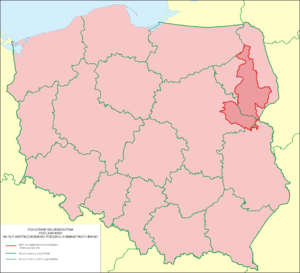 Podlachia Proper | ||
| Country |  Poland Poland | |
| Former capital | Drohiczyn | |
| Time zone | UTC+1 (CET) | |
| • Summer (DST) | UTC+2 (CEST) | |


Historic Podlachian borders in green

The Podlaskie Voivodeship in the Polish–Lithuanian Commonwealth in 1635.

Drohiczyn and Bug river.

Orthodox sanctuary in Grabarka.
Podlachia[1] or Podlasie,[2] (Polish: Podlasie, Belarusian: Падляшша Padliašša, Lithuanian: Palenkė) is a historical region in the eastern part of Poland. Between 1513 and 1795 it was a voivodeship with the capital in Drohiczyn. Now the part north of the Bug River is included in the modern Podlaskie Voivodeship with the capital in Białystok.
Contents
1 Names and etymology
2 Subregions
3 History
4 Ethnic situation
5 Cities and towns
6 References
Names and etymology
The region is called Podlasie, Podlasko or Podlasze in Polish, Palenkė in Lithuanian, Padliašša (Падляшша) in Belarusian, Pidlissja (Підлісся), Pidljasije (Підлясіє), Pidljaššja (Підляшшя) or Pidljaxija (Підляхія) in Ukrainian, Podljas’e (Подлясье) in Russian, "Podlyashe" (פּאָדליאַשע) in Yiddish, and Podlachia in Latin.
There are two opinions regarding the origin of the name of the region. Commonly people derive it from the Slavic word les or las meaning "forest", i.e., it is an "by the wood(s)" or "area of forests", making Podlachia close in meaning to adjacent Polesia. The theory has been questioned, as it does not properly take into consideration the vowel shifts "a" > "e" > "i" in various Slavic languages (in fact, it mixes vowels from different languages).
The second opinion holds that the term comes from the expression pod Lachem, which may be translated literally as "under the Poles" (see: Lechia). Some claim it to mean "under Polish rule", though in the Middle Ages Podlachia was only partially under Polish rule, and since 1446 until 1569 the area belonged to the Grand Duchy of Lithuania. A better variant of this theory holds that the name originates from the period when the territory was within the Trakai Voivodeship of the Grand Duchy of Lithuania, along the borderline with the Mazovia province, primarily a fief of the Poland of the Piasts and later on part of the Kingdom of Poland of the Jagiellons. Hence pod Lachem would mean "near the Poles", "along the border with Poland". The historical Lithuanian name of the region, Palenkė, has exactly this meaning.[citation needed]
Subregions
Podlachia is divided along the Bug River, at which the traditional capital Drohiczyn lies, into northern and southern parts. The former is included in the modern-day Podlaskie Voivodeship with its capital at Białystok (the historical boundary goes exactly through the city). Sometimes, Siedlce has been considered the capital of the region.
History
Throughout its early history, Podlachia was inhabited by various tribes of different ethnic roots. In the 9th and 10th centuries, the area was likely inhabited by Lechitic tribes in the south, Baltic (Yotvingian) tribes in the north, and Ruthenian tribes in the east.[citation needed] Between the 10th and 14th centuries, the area was part of the Ruthenian principalities and Polish and Mazovian Piast states. The area became perhaps a part of the Medieval Slavic territory of Cherven Cities.[citation needed] In the 14th century the area was annexed by the Grand Duchy of Lithuania, though later on it still briefly fell under Mazovian Piast rule. In 1446, Podlachia became part of the Grand Duchy, but since 1496 southwestern parts of Podlachia (Drohiczyn Land and Mielnik Land) and since 1501 the northern part (Bielsk Land) used Polish law instead of Lithuanian. In 1513 King Sigismund I the Old formed the Podlaskie Voivodeship (adjective of Podlasie). In 1566, the southeastern part of Podlachia became part of the newly formed Brest Litovsk Voivodeship as the Brest Litovsk County. In 1569, after the Union of Lublin, Podlasie was ceded to the Kingdom of Poland. It was the northernmost part of the Lesser Poland Province of the Polish Crown. The voivodeship was divided in three lands: the Drohiczyn, Mielnik and Bielsk Land. In the 18th and 19th century the private town of Białystok became the main center of the region, thanks to the patronage of the Branicki family and the textile industry development. After the Third Partition of Poland in 1795, Podlachia was divided between the Kingdom of Prussia, the Habsburg Monarchy and the Russian Empire. In 1807, the western part of Podlachia became part of the Duchy of Warsaw, a semi-independent Polish entity, while the eastern part including Białystok fell under Russian rule. In the 19th century the region was a stronghold of Polish resistance against Russian rule. The last partisan of the January Uprising Stanisław Brzóska operated here until 1865. He was hanged publicly by the Russians in Sokołów Podlaski in May 1865. Poland regained Podlachia after restoring independence in 1918.
Ethnic situation
Podlachia is the land of the confluence of cultures – mainly Polish and Belarusian – and is indicative of the ethnic territories limits. East of Podlachia lie ethnically non-Polish lands, while westward ethnically non-Ruthenian. Today, Polish is spoken in western, northern and southern Podlachia, while Belarusian in eastern areas.
Until the 19th century, Podlachia was populated by the Polish-speaking yeomanry (drobna szlachta), Jews (primarily in towns), and Ruthenian Greek-Catholics speaking a dialect related to modern Ukrainian[citation needed] – the so-called Khakhlak (Chachlak) dialect, which derived its name from a derogatory term for Ukrainians (khakhol or khokhol being the name of the traditional haircut of Ukrainian Cossacks).
In the 19th century, the inhabitants of Podlachia were under the rule of the Russian Empire, with southern Podlachia constituting a part of Russian-controlled Congress Poland. After 1831, Russian authorities forbade the Greek-Catholic faith in northern Podlachia and it disappeared from the area. In 1875, Russians forbade this rite in the southern portion as well, and all Greek-Catholic inhabitants were forced to accept the Eastern Orthodox faith. However, the resistance of the local people was surprisingly strong and Ruthenian speakers from this area rejected the separation from the Pope. In 1874, blessed Wincenty Lewoniuk and 12 companions were killed by Russian soldiers in Pratulin. In reaction to these measures, the Ruthenians of southern Podlachia began to identify themselves with the national movement of the Roman Catholic Poles. To preserve the full communion with the Pope, they changed their rite from Eastern to Latin before the compulsory conversion of Greek Catholics into Orthodox. In 1912, Russian authorities issued a tolerance edict that made it possible to change confession from Orthodox to Roman Catholic (but not to Greek-Catholic, which had been completely deleted). A majority of the inhabitants of southern Podlachia changed their faith from Orthodox to Roman Catholic. At present, very few people in this area speak Ruthenian and nearly all consider themselves Poles. Meanwhile, the eastern part of northern Podlachia is still populated by Belarusians.
Podlachia is also the cultural center of Poland's small Tatar minority as well.[citation needed] After the annexation of eastern Poland into the Soviet Union following World War II, Poland was left with only 2 Tatar villages, Bohoniki and Kruszyniany (both outside the historical borders of Podlachia). Some Tatars from the territories annexed to the USSR have been repatriated to Poland and clustered in cities, particularly Białystok.[citation needed] In 1925 the Muslim Religious Union (Muzułmański Związek Religijny) was formed in Białystok. In 1992, the Union of Tatars of the Republic of Poland (Związek Tatarów Rzeczypospolitej Polskiej) with autonomous branches in Białystok and Gdańsk began operating.
Cities and towns

Branicki Palace in Białystok - the largest city of proper Podlachia

The former royal city of Augustów is the northernmost city of Podlachia and a popular summer tourist destination

Baroque town hall in Bielsk Podlaski, a former royal city of Poland and capital of Bielsk Land

Hajnówka is notable for its proximity to the Białowieża Forest, the biggest primaeval forest in Europe

Sanctuary in Sokołów Podlaski

Congregation of the Mission Monastery in Siemiatycze
| City | Population (2015/16)[3] | Pop. (1931) | Administrative division | Additional information | |
|---|---|---|---|---|---|
| 1. | Brest | 340,141 | 48,431 | Brest Region | Part of Podlachia until 1566, after 1566 it is rather considered part of Polesia; former royal city of Poland. |
| 2. | Białystok | 295,981 | 91,335 | Podlaskie Voivodeship | Former private town of the Branicki family. |
| 3. | Biała Podlaska | 57,414 | 17,549 | Lublin Voivodeship | Part of Podlachia until 1566, after 1566 it was rather considered part of Polesia, nowadays the area is referred to as Southern Podlachia; former private town of the Radziwiłł family. |
| 4. | Kobryn | 52,655 | 10,101 | Brest Region | Part of Podlachia until 1566, after 1566 it is rather considered part of Polesia. |
| 5. | Augustów | 30,449 | 12,147 | Podlaskie Voivodeship | Former royal city of Poland. |
| 6. | Byaroza | 29,408 | 4,521 | Brest Region | Area was part of Podlachia until 1566, after 1566 it is rather considered part of Polesia. |
| 7. | Bielsk Podlaski | 26,336 | 7,029 | Podlaskie Voivodeship | Former royal city of Poland, capital of Bielsk Land. |
| 8. | Hajnówka | 21,559 | Podlaskie Voivodeship | ||
| 9. | Sokołów Podlaski | 18,720 | 9,901 | Masovian Voivodeship | Former private town of the Kiszka and Radziwiłł families. |
| 10. | Pruzhany | 18,459 | 8,013 | Brest Region | Part of Podlachia until 1566, after 1566 it is rather considered part of Polesia. |
| 11. | Międzyrzec Podlaski | 17,117 | 16,837 | Lublin Voivodeship | Part of Podlachia until 1574, after 1574 it was rather considered part of Polesia, nowadays the area is referred to as Southern Podlachia, former private town. |
| 12. | Łapy | 16,005 | 6,674 | Podlaskie Voivodeship | |
| 13. | Siemiatycze | 14,766 | 6,816 | Podlaskie Voivodeship | Former private town of the Jabłonowski family. |
| 14. | Włodawa | 13,643 | 8,519 | Lublin Voivodeship | Part of Podlachia until 1566, after 1566 it was rather considered part of Polesia, nowadays the area is referred to as Southern Podlasie; former private town. |
| 15. | Zhabinka | 13,357 | Brest Region | Area was part of Podlachia until 1566, after 1566 it is rather considered part of Polesia. | |
| 16. | Węgrów | 12,796 | 9,416 | Masovian Voivodeship | Former private town of the Radziwiłł family, westernmost town of Podlachia. |
| 17. | Malaryta | 11,823 | Brest Region | Area was part of Podlachia until 1566, after 1566 it is rather considered part of Polesia. | |
| 18. | Mońki | 10,352 | Podlaskie Voivodeship | ||
| 19. | Wysokie Mazowieckie | 9,503 | 3,977 | Podlaskie Voivodeship | Former private town. |
| 20. | Kamyenyets | 8,405 | 3,001 | Brest Region | Part of Podlachia until 1566, after 1566 it is rather considered part of Polesia. |
| 21. | Łosice | 7,099 | 5,026 | Masovian Voivodeship | Former royal city of Poland. |
| 22. | Terespol | 5,815 | 2,308 | Lublin Voivodeship | Part of Podlachia until 1566, after 1566 it was rather considered part of Polesia, nowadays the area is referred to as Southern Podlachia; former private town. |
| 23. | Choroszcz | 5,782 | 2,905 | Podlaskie Voivodeship | |
| 24. | Vysokaye | 5,164 | 2,739 | Brest Region | Area was part of Podlachia until 1566, after 1566 it is rather considered part of Polesia. |
| 25. | Ciechanowiec | 4,840 | 4,029 | Podlaskie Voivodeship | Former private town. |
| 26. | Brańsk | 3,867 | 4,204 | Podlaskie Voivodeship | Former royal city of Poland. |
| 27. | Knyszyn | 2,850 | 4,123 | Podlaskie Voivodeship | Former royal city of Poland, royal residence of King Sigismund II Augustus. |
| 28. | Szepietowo | 2,282 | Podlaskie Voivodeship | Youngest town of Podlachia. | |
| 29. | Kosów Lacki | 2,187 | Masovian Voivodeship | ||
| 30. | Drohiczyn | 2,125 | 2,309 | Podlaskie Voivodeship | Historical capital of Podlachia, former royal city of Poland, capital of Drohiczyn Land. |
| 31. | Tykocin | 2,014 | 3,290 | Podlaskie Voivodeship | |
| 32. | Goniądz | 1,900 | 3,449 | Podlaskie Voivodeship | Former royal city of Poland. |
| 33. | Mordy | 1,819 | 3,287 | Masovian Voivodeship | Former private town of the Radziwiłł and Ciecierski families. |
| 34. | Rajgród | 1,626 | 2,432 | Podlaskie Voivodeship | Former royal city of Poland. |
| 35. | Kleszczele | 1,345 | 2,029 | Podlaskie Voivodeship | Former royal city of Poland. |
| 36. | Suraż | 1,008 | 1,379 | Podlaskie Voivodeship | Former royal city of Poland. |
References
^ Paul Robert Magocsi. Historical Atlas of Central Europe: From the early fifth century to the present. Thames & Hudson, 2002.
- William Fiddian Reddaway. The Cambridge History of Poland: Volume 2. 1971.
- Zigmantas Kiaupa. The History of Lithuania. Baltos Lankos, 2005. p.52.
- Zenon E. Kohut, Bohdan Y. Nebesio, Myroslav Yurkevich. Historical Dictionary of Ukraine. Scarecrow Press, 2005.
- Jerzy Kłoczowski. A History of Polish Christianity. Cambridge University Press, 2000, p.268.
^ Bedford, Neal (2008). Poland. Lonely Planet. pp. 138–139. ISBN 978-1-74104-479-9..mw-parser-output cite.citationfont-style:inherit.mw-parser-output .citation qquotes:"""""""'""'".mw-parser-output .citation .cs1-lock-free abackground:url("//upload.wikimedia.org/wikipedia/commons/thumb/6/65/Lock-green.svg/9px-Lock-green.svg.png")no-repeat;background-position:right .1em center.mw-parser-output .citation .cs1-lock-limited a,.mw-parser-output .citation .cs1-lock-registration abackground:url("//upload.wikimedia.org/wikipedia/commons/thumb/d/d6/Lock-gray-alt-2.svg/9px-Lock-gray-alt-2.svg.png")no-repeat;background-position:right .1em center.mw-parser-output .citation .cs1-lock-subscription abackground:url("//upload.wikimedia.org/wikipedia/commons/thumb/a/aa/Lock-red-alt-2.svg/9px-Lock-red-alt-2.svg.png")no-repeat;background-position:right .1em center.mw-parser-output .cs1-subscription,.mw-parser-output .cs1-registrationcolor:#555.mw-parser-output .cs1-subscription span,.mw-parser-output .cs1-registration spanborder-bottom:1px dotted;cursor:help.mw-parser-output .cs1-ws-icon abackground:url("//upload.wikimedia.org/wikipedia/commons/thumb/4/4c/Wikisource-logo.svg/12px-Wikisource-logo.svg.png")no-repeat;background-position:right .1em center.mw-parser-output code.cs1-codecolor:inherit;background:inherit;border:inherit;padding:inherit.mw-parser-output .cs1-hidden-errordisplay:none;font-size:100%.mw-parser-output .cs1-visible-errorfont-size:100%.mw-parser-output .cs1-maintdisplay:none;color:#33aa33;margin-left:0.3em.mw-parser-output .cs1-subscription,.mw-parser-output .cs1-registration,.mw-parser-output .cs1-formatfont-size:95%.mw-parser-output .cs1-kern-left,.mw-parser-output .cs1-kern-wl-leftpadding-left:0.2em.mw-parser-output .cs1-kern-right,.mw-parser-output .cs1-kern-wl-rightpadding-right:0.2em
- Chorzempa, Rosemary A. (2009). Polish Roots. Genealogical Publishing Com. pp. 84–85. ISBN 0-8063-1378-1.
- Oskar Halecki; W: F. Reddaway; J. H. Penson. The Cambridge History of Poland. Cambridge University Press. pp. 363–364. ISBN 978-1-00-128802-4.
- The Gate of Podlasie
- Podlasie
- Introducing Mazovia & Podlasie
- Podlasie24
- Podlasie Jazz Festival
^ http://www.polskawliczbach.pl/Miasta
Authority control  |
|
|---|


