Indiana Hoosiers men's basketball
| Indiana Hoosiers | |||
|---|---|---|---|
| |||
 | |||
| University | Indiana University | ||
| First season | 1901 | ||
| All-time record | 1,823–1,036 (.638) | ||
| Athletic director | Fred Glass | ||
| Head coach | Archie Miller (2nd season) | ||
| Conference | Big Ten | ||
| Location | Bloomington, Indiana | ||
| Arena | Simon Skjodt Assembly Hall (Capacity: 17,222) | ||
| Nickname | Hoosiers | ||
| Student section | Crimson Guard | ||
| Colors | Crimson and Cream[1] | ||
| Uniforms | |||
| |||
| NCAA Tournament champions | |||
| 1940, 1953, 1976, 1981, 1987 | |||
| NCAA Tournament runner-up | |||
| 2002 | |||
| NCAA Tournament Final Four | |||
| 1940, 1953, 1973, 1976, 1981, 1987, 1992, 2002 | |||
| NCAA Tournament Elite Eight | |||
| 1940, 1953, 1973, 1975, 1976, 1981, 1984, 1987, 1992, 1993, 2002 | |||
| NCAA Tournament Sweet Sixteen | |||
| 1953, 1954, 1958, 1967, 1973, 1975, 1976, 1978, 1980, 1981, 1983, 1984, 1987, 1989, 1991, 1992, 1993, 1994, 2002, 2012, 2013, 2016 | |||
| NCAA Tournament appearances | |||
| 1940, 1953, 1954, 1958, 1967, 1973, 1975, 1976, 1978, 1980, 1981, 1982, 1983, 1984, 1986, 1987, 1988, 1989, 1990, 1991, 1992, 1993, 1994, 1995, 1996, 1997, 1998, 1999, 2000, 2001, 2002, 2003, 2006, 2007, 2008, 2012, 2013, 2015, 2016 | |||
| Conference regular season champions | |||
| 1926, 1928, 1936, 1953, 1954, 1957, 1958, 1967, 1973, 1974, 1975, 1976, 1980, 1981, 1983, 1987, 1989, 1991, 1993, 2002, 2013, 2016 | |||






The Indiana Hoosiers men's basketball team represents Indiana University in NCAA Division I college basketball and competes in the Big Ten Conference. The Hoosiers play on Branch McCracken Court at Simon Skjodt Assembly Hall in Bloomington, Indiana on the Indiana University Bloomington campus. Indiana has won five NCAA Championships in men's basketball (1940, 1953, 1976, 1981, 1987) — the first two under coach Branch McCracken and the latter three under Bob Knight. Indiana's 1976 squad remains the last undefeated NCAA men's basketball champion.[2][3][4][5]
The Hoosiers are sixth in NCAA Tournament appearances (39), sixth in NCAA Tournament victories (66), eighth in Final Four appearances (8), and 11th in overall victories.[6] The Hoosiers have won 22 Big Ten Conference Championships and have the best winning percentage in conference games at nearly 60 percent. No team has had more All-Big Ten selections than the Hoosiers with 53. The Hoosiers also rank seventh in all-time AP poll appearances (554) and sixth in the number of weeks spent ranked No. 1 (54).[7] Every four-year men's basketball letterman since 1973 has earned a trip to the NCAA basketball tournament. Additionally, every four-year player since 1950 has played on a nationally ranked squad at Indiana.[8]
The Hoosiers are among the most storied programs in the history of college basketball. A 2018 study listed Indiana as the second most valuable collegiate basketball program in the country.[9] Indiana has ranked in the top 20 nationally in men's basketball attendance every season since Assembly Hall opened in 1972, and often in the top five.[10]
Indiana has three main rivalries including in-state, against the Purdue Boilermakers (see Indiana–Purdue rivalry), and out-of-state, against the Kentucky Wildcats (see Indiana–Kentucky rivalry) and the Illinois Fighting Illini (see Illinois–Indiana rivalry).
Contents
1 Traditions
1.1 Candy striped warm-up pants
1.2 Simple game jerseys
1.3 William Tell Overture
1.4 "Mop Lady" advertisement
2 History
2.1 Early years (1900–1924)
2.2 Everett Dean era (1924–1938)
2.3 Branch McCracken era (1938–1965)
2.4 Lou Watson era (1965–1971)
2.5 Bob Knight era (1971–2000)
2.6 Mike Davis era (2000–2006)
2.7 Kelvin Sampson era (2006–2008)
2.8 Tom Crean era (2008–2017)
2.9 Archie Miller era (2017–present)
3 Season-by-season records
4 Current Roster
5 Facilities
5.1 Old Assembly Hall (1900–1917)
5.2 Men's Gymnasium (1917–1928)
5.3 Wildermuth Intramural Center (1928–1960)
5.4 Gladstein Fieldhouse (1960–1971)
5.5 Simon Skjodt Assembly Hall (1971–present)
5.6 Cook Hall (2010–present)
6 Coaching history
7 Notable players and coaches
7.1 1,000-point scorers
7.2 National Players of the Year
7.3 All-Americans
7.4 Academic All-Americans
7.5 McDonald's All-Americans
7.6 Indiana Mr. Basketballs
7.7 Coaching honors
7.8 Big Ten Conference honors
7.9 Naismith Memorial Basketball Hall of Famers
7.10 National Collegiate Basketball Hall of Famers
7.11 Current NBA players
7.12 Olympians
8 School records
8.1 Conferences
8.2 Record vs. Big Ten opponents
8.3 Team season records
8.4 Individual career
9 Career leaders
10 Postseason appearances
10.1 NCAA Tournament
10.2 NCAA Tournament seeding history
10.3 Complete NCAA Tournament results
10.4 NIT Results
10.5 CCAT Results
10.6 Big Ten regular-season championships
11 Tournament Titles
12 Key Statistics
12.1 Rankings
12.2 Victories over AP number 1 teams
13 Radio network affiliates
14 See also
15 References
16 External links
Traditions
Candy striped warm-up pants
Indiana players wear warm-up pants that are striped red and white, like the stripes of a candy cane. They were first worn by the team in the 1970s under head coach Bob Knight.[11] At the time they were in keeping with the fashion trends of the 1970s, but despite changing styles they have since become an iconic part of playing for Indiana. IU star guard Steve Alford said, "As you watch television and you watch the IU games, that's the first thing you saw, was the team run out in the candy stripes. So when you finally got to put those on, those are pretty special."[11] Rusty Stillions, Director of Indiana's Equipment Operations, said the pants were originally available only for team members. However, changes in licensing agreements permitted the general public to buy them as well.[11] They have since become a staple at games and other Indiana basketball events.
Simple game jerseys

Players huddle before a game in their iconic candy striped pants
The team is widely noted for their simple game jerseys. Unlike most schools, Indiana doesn't have players' names on the back of jerseys that players wear on the court.[12] The notion behind the nameless jerseys is that players play for the team name on the front, not the individual's name on the back. In keeping with Indiana's longstanding principle of putting team over player, the Hoosiers have never retired any jersey numbers. Adidas is the current outfitter of Indiana athletics.
When coach Mike Davis succeeded Bob Knight, he suggested adding names to the jerseys. However, the Hoosiers' minimalist look had become such a part of the program's brand that the proposal was dropped after considerable backlash from fans.[13] Despite the long tradition behind the jerseys, they have undergone some slight changes over the years. The school's colors are cream and crimson, but in the 1970s Knight and football coach Lee Corso started using uniforms that were more scarlet or bright red.[14] During the same time, cream gave way almost universally to white. But those colors reverted mostly to cream and crimson in the early 2000s, after then-athletics director Michael McNeely decided that the team uniforms needed to reflect the school's official colors of cream and crimson.
William Tell Overture
During the third time-out of every second half, the Indiana Big Red Basketball Band performs the William Tell Overture with cheerleaders racing around the court carrying myriad flags that spell out "Indiana Hoosiers." Indiana Assistant Director for Facilities, Chuck Crabb, said the tradition began in about 1979 or 1980.[15] Sportscaster Billy Packer called it "the greatest college timeout in the country."[15]
"Mop Lady" advertisement
In 1971, Indiana Farm Bureau Insurance became the sole sponsor of Indiana and Purdue games on WTTV.[16] During the mid-1970s, the State Farm Indiana Legends ads included a lady named "Martha" sweeping the floors of Assembly Hall while whistling and singing the school's fight song, "Indiana, Our Indiana." It ran as the introduction to Indiana basketball broadcasts for 30 years. Upon Indiana's firing of Bob Knight, Farm Bureau pulled the ad.[16] In 2009 new coach Tom Crean resurrected the tradition and had "Martha" appear at the "Midnight Madness" festivities to begin the season. Because the actress who had appeared in the original ads was unavailable, singer Sheila Stephen stepped in as the new Martha. Starting with the 2010–11 season, video of the original ad was shown at home games after the National Anthem and right before tip off.[17] In recent years, the ad has been shown just before the Hoosiers take the court.
History
Early years (1900–1924)

The first Indiana basketball team (1900–01)
Indiana fielded its first men's basketball team in the 1900–01 season, posting a 1–4 ledger under coach James H. Horne. In their first game the Hoosiers traveled to Indianapolis and lost to Butler 17–20.[18] Indiana's first victory was a 26–17 win over Wabash College that same year.[18]
In 1917 the Hoosiers began playing their games at the Men's Gymnasium. After the first few games there, spectators complained that they couldn't see the game because of opaque wooden backboards. Therefore, new backboards were installed that contained one-and-a-half inch thick plate glass allowing fans to see games without an obstructed view. As a result, it was the first facility (thus the Hoosiers were the first team) in the country to use glass backboards.[19]
Everett Dean era (1924–1938)
IU's first great head coach, Everett Dean, was at first a standout player who garnered IU's first All-America honors in 1921.[18] In 1924, Dean signed on as the full-time head coach of his alma mater.[18] Under Dean, the Hoosiers would elevate their play to new heights, winning their first-ever share of the Big Ten Conference title in 1926, defeating Wisconsin 35–20. The Hoosiers also won conference championships in 1928 and 1936. Four All-Americans helped lead the Hoosiers in this era: Jim Strickland, Branch McCracken (later coach), Vern Huffman, and Ken Gunning. Dean coached Indiana until 1938. He is the only coach named to both the Naismith Basketball Hall of Fame and the College Baseball Hall of Fame.[18]
Branch McCracken era (1938–1965)
When Dean left for Stanford, the popular selection to succeed him was Branch McCracken.[20] McCracken was another young alumnus and former player under Everett Dean.[20] Because of his fast-breaking style of play, McCracken's teams would earn the nickname "Hurryin' Hoosiers".
McCracken's first IU team was led by All-America Ernie Andres, later a McCracken basketball assistant.[18] In McCracken's first year, the team finished 17–3, splitting games with both Purdue and eventual NCAA runnerup Ohio State.[18] The following year the 1939–40 NCAA title team, led by All-American Marvin Huffman, would take Indiana to unprecedented success: an NCAA title and a record (at the time) 20 wins.[20] The 20–3 record by that team would not be bested for another 13 years until broken again by Indiana.[20] At their home court at The Fieldhouse, Indiana saw six perfect seasons including a 24-game unbeaten home winning streak from 1938–1941. In 1948, McCracken was responsible for recruiting Bill Garrett who became the first African American player in Big Ten varsity basketball history.
The Hoosiers' 1952–53 NCAA title team – led by Bobby Leonard, Dick Farley, and three-time All-American Don Schlundt – won the Big Ten and went on to win the NCAA championship by defeating reigning champions Kansas by one point. The Hoosiers would again win the Big Ten the following season in 1953–54. Just a few years later the team won back-to-back conference championships in 1956–57 and 1957–58 behind the leadership of two-time All-American Archie Dees. A few years later the Hoosiers were led by two-time All-American Walt Bellamy, one of the few African-American players in college basketball at the time.
In the fall of 1960 the Indiana Hoosiers football program was hit with devastating NCAA sanctions that impacted every varsity sport at the school, including basketball.[21] Although the violations only occurred within the football program, all Hoosier varsity sports were barred from postseason play during the probationary period.[21] The sanctions drastically undermined the ability of coaches to lure talented players to Indiana. Nevertheless, McCracken did manage to successfully recruit twins Dick Van Arsdale and Tom Van Arsdale, both of whom would earn All-America honors in 1965.
McCracken ultimately coached IU for 23 years, amassing 364 wins and 210 Big Ten wins.[18] His teams also won four regular season Big Ten titles and went to the NCAA tournament four times, winning two national titles.[18] He was inducted into the National Basketball Hall of Fame and the court now at Assembly Hall is named in his honor.
Lou Watson era (1965–1971)
Sandwiched between two iconic coaches in Branch McCracken and Bob Knight, McCracken's longtime assistant and former lead scorer Lou Watson coached Indiana from 1965 through 1971, with a leave of absence in 1970 where Jerry Oliver stepped in as acting head coach. The 1966–67 team, which won a Big Ten championship, was known as the "Cardiac Kids" because of their many heart-stopping finishes. During the 1970–1971 season the Hoosiers were led by All-American George McGinnis. Watson ended his Indiana coaching career with a 61–60 record.
Bob Knight era (1971–2000)
During Bob Knight's 29 years as head coach at Indiana, the Hoosiers won 662 games, including 22 seasons of 20 or more wins, while losing but 239, a remarkable .735 winning percentage. In 24 NCAA tournament appearances at Indiana, Hoosier teams under Bob Knight won 42 of 63 games (.667), winning titles in 1975–76, 1980–81, and 1986–87, while finishing third in 1973 and 1992. While at Indiana, a total of 23 different players under Coach Knight's tutelage received All-American and All-Big Ten honors. For 10-consecutive seasons, a player made the All-American Academic and All-Big Ten Academic Teams, and a total of 18 players were so honored. Nine Indiana players won 10 Big Ten Most Valuable Player honors.

Kent Benson of the 1976 NCAA Championship team scoring in a Big Ten game against Illinois in 1977
In 1972–73, Knight's second year as coach, Indiana won the Big Ten championship and reached the Final Four, but lost to UCLA. The following season, 1973–74, Indiana once again captured a Big Ten title. In the two following seasons, 1974–75 and 1975–76, the Hoosiers were undefeated in the regular season and won 37-consecutive Big Ten games, including two more Big Ten championships. The 1974–75 Hoosiers swept the entire Big Ten by an average of 22.8 points per game. However, in an 83–82 win against Purdue they lost consensus All-American forward Scott May to a broken left arm. With May's injury keeping him to 7 minutes of play, the No. 1 Hoosiers lost to Kentucky 92–90 in the Mideast Regional. The Hoosiers were so dominant that four starters – Scott May, Steve Green, Kent Benson and Quinn Buckner – would make the five-man All-Big Ten team. The following season, 1975–76, the Hoosiers went the entire season and 1976 NCAA tournament without a single loss, beating Michigan 86–68 in the title game. Indiana remains the last school to accomplish this feat.[22][23]
Behind the play of Mike Woodson Indiana won the 1979 NIT championship. The 1979–80 Hoosiers, led by Woodson and Isiah Thomas, won the Big Ten championship and advanced to the 1980 Sweet Sixteen. The following season, in 1980–81, Thomas and the Hoosiers once again won a conference title and won the 1981 NCAA tournament, the school's fourth national title. In 1982–1983, with the strong play of Uwe Blab and All-Americans Ted Kitchel and Randy Wittman, the No. 1 ranked Hoosiers were favorites to win another national championship. However, with an injury to Kitchel mid-season, the Hoosiers' prospects were grim. Knight asked for fan support to rally around the team and, when the team ultimately won the Big Ten title, he ordered that a banner be hung for the team in Assembly Hall as a tribute to the fans, who he credited with inspiring the team to win its final three home games. Nevertheless, in the tournament Kitchel's absence was felt and the team lost to Kentucky in the 1983 Sweet Sixteen.
The 1985–86 Hoosiers were profiled in a best-selling book A Season on the Brink. To write it Knight granted author John Feinstein almost unprecedented access to the Indiana basketball program, as well as insights into Knight's private life. The following season, in 1986–87, the Hoosiers were led by All-American Steve Alford and captured a share of the Big Ten title. The team won Indiana's fifth national championship against Syracuse in the 1987 NCAA tournament with a game-winning jump shot by Keith Smart with five seconds of play remaining in the championship game.[24] In the 1988–1989 season the Hoosiers were led by All-American Jay Edwards and won a Big Ten championship.
From 1990–91 through 1992–93, the Hoosiers posted 87 victories, the most by any Big Ten team in a three-year span, breaking the mark of 86 set by Knight's Indiana teams of 1974–76. Teams from these three seasons spent all but two of the 53 poll weeks in the top 10, and 38 of them in the top 5. They captured two Big Ten crowns in 1990–91 and 1992–93, and during the 1991–92 season reached the Final Four. During the 1992–93 season, the 31–4 Hoosiers finished the season at the top of the AP Poll, but were defeated by Kansas in the Elite Eight. Teams from this era included Greg Graham, Pat Knight, All-Americans Damon Bailey and Alan Henderson, and National Player of the Year Calbert Cheaney.
Throughout the mid and late 1990s Knight and the Hoosiers continued to experience success with superior play from All-Americans Brian Evans and A. J. Guyton. The Hoosiers won a minimum of 19 games and played in the NCAA Tournament each year. However, 1993 would be Knight's last conference championship and 1994 would be his last trip to the Sweet Sixteen. Moreover, his portrayal in the media often brought as much controversy to the school as success. The controversial reputation, combined with a strained relationship with then-University President Myles Brand, resulted in Knight's controversial dismissal in 2000.[25]
Mike Davis era (2000–2006)
Following Bob Knight's tumultuous exit from Indiana, assistant Mike Davis took over as interim head coach in the fall of 2000. In his first season, Davis led a team featuring All-Americans Kirk Haston and Jared Jeffries to a 21–13 record. The following year, in the 2001–02 season, Davis was named the permanent coach. That year the Hoosiers captured a share of the Big Ten championship and made an unexpected trip to the 2002 NCAA championship game. But after the Hoosiers failed to make the NCAA Tournament in 2004 and 2005 (for the first time since 1985), criticism of Davis grew. Following months of speculation, he announced his resignation in February 2006, saying the basketball program needed to move on with a new coach. He remained with the team for the rest of the 2006 season before leaving.[26]
Kelvin Sampson era (2006–2008)
On March 28, 2006, Oklahoma head coach Kelvin Sampson was named coach of the Hoosiers, despite a history of violating NCAA rules and sanctions imposed on him.[27] Sampson fielded competitive teams and scored a major recruiting victory by persuading in-state star Eric Gordon to sign with Indiana.[28] The Hoosiers, with Gordon and forward D.J. White, were considered one of the better teams during the 2007–2008 season. However, in October 2007 Sampson was found to have violated rules again, this time by engaging in a 3-way phone conversation with a recruit. Indiana punished Sampson by denying him a previously scheduled $500,000 raise, firing one of his assistant coaches, and taking away one of his scholarships for the 2008–2009 season.[29]
In early February 2008 the NCAA informed Indiana that Sampson had "knowingly violated telephone recruiting restrictions and then lied about it." After launching another internal investigation, Indiana officials announced just 14 days later that Sampson accepted a $750,000 buyout of his contract and resigned as the men's basketball coach.[30] Former player and assistant coach Dan Dakich was named Interim Head Coach. In November 2008, the NCAA imposed a three-year probation on the basketball program and upheld the school's self-imposed sanctions stemming from the actions of Sampson and his staff.[31]
Tom Crean era (2008–2017)
On April 1, 2008, Tom Crean was hired as head coach and inherited a thoroughly depleted team.[32] Between Crean's hiring and the start of the 2008–09 season, freshman Eric Gordon opted to leave early for the NBA and star forward DJ White graduated. Two other players transferred and three others were kicked off the team. As a result, Crean began with a roster consisting of two walk-ons who had scored a combined 36 points in their careers.[33] As a result, Crean's first three seasons saw losing records of 6–25 record (the worst in school history), 10–21, and 12–20. However, during this period Crean's recruiting classes progressively improved, most notably with the signing of five-star recruit and McDonald's All-American Cody Zeller.
The 2011–2012 season was a watershed one for Crean and the program, which saw a 27–9 record and a sweet 16 appearance. The team earned wins over the #1 ranked Kentucky, the #2 ranked Ohio State, and #5 ranked Michigan State. This made Indiana the first Big 10 program to knock off the #1 and #2 ranked teams in the same season since 1991 and the first IU squad ever to defeat three programs ranked in the top five in the regular season.[34][35] The fifteen game win improvement in 2011–2012 was the largest single turnaround in the NCAA that season.[36] Crean's guidance of the program to success from "unthinkable depths" was regarded as one of the most remarkable rebuilding projects in NCAA basketball history.[33] The Hoosiers advanced to the Sweet Sixteen in the 2012 NCAA Tournament before losing a rematch game to Kentucky, who would go on to win the national championship. Following the surprise run to the Sweet Sixteen, the 2012–2013 Hoosiers spent 10 weeks ranked #1 in the country, and all but two weeks in the top 5.[37] The experience of Jordan Hulls and Christian Watford, alongside the talent of Victor Oladipo and Cody Zeller, led this team to a finish of outright Big Ten regular season champions for the first time since 2002. They again advanced to the Sweet Sixteen, the first time since the 1992–93 and 1993–94 seasons that the Hoosiers advanced to the Sweet Sixteen in back-to-back seasons. As national player of the year, Oladipo and Zeller both left for the NBA after the conclusion of the season.
After a rough start, the 2015–2016 Hoosiers finished the season 27–8 overall and 15–3 in the Big Ten to win the Big Ten regular season title outright. They received the #1 seed in the 2016 Big Ten Conference Men's Basketball Tournament, where they made an early quarterfinals exit. As Big Ten Conference Champions, the Hoosiers received an at-large bid to the NCAA Tournament and beat Chattanooga and Kentucky to advance to the Sweet 16 for the third time in five years; however, they fell to North Carolina in the next round. Despite the highs of the previous season and being ranked as high as #3 in the nation, the 2016–2017 team faced a troubling and disappointing year; they finished 18–16 overall and 7–11 in Big Ten play. After tying for tenth in the Big Ten, the Hoosiers missed out on the NCAA Tournament and lost in the first round of the NIT, their first appearance since 2005. On March 16, 2017, the Indiana Hoosiers Athletic's Department fired coach Tom Crean.[38] He ended his tenure with the Hoosiers with an overall record of 166–135 (.551), three Sweet Sixteen appearances, and two regular season conference championships.
Archie Miller era (2017–present)
On March 27, 2017, Archie Miller was named the 29th head coach in the history of the men's basketball program.[39] Miller's first season was a major remodeling job, starting with laying the foundation of a pack-line defense and valuing possessions. Early in the season, Miller stated practices were 75% defense, 25% offense.[40] That scheme showed early and often, as the Hoosiers struggled mightily throughout the season to find any flow or rhythm on offense, despite the defense making leaps and bounds in the overall rankings of Division 1 basketball.[41] With a surprising early second round loss in the 2018 Big Ten Tournament to Rutgers, 67–76, and losing enough games to keep them out of both the NCAA tournament and NIT, including games in which they were favored, such as Indiana State[42] and Fort Wayne,[43] IU’s first season under their new coach came to a disappointing close. They finished with an overall record of 16–15 and 9–9 in the Big Ten.
In 2018, Miller landed his first five star recruit when Romeo Langford committed to Indiana University. Langford, a McDonald's-All American and 2018 Indiana Mr. Basketball, was (according to ESPN) the 6th ranked player in the nation and number one high school player in Indiana.
Season-by-season records
| Season | Coach | Overall | Conference | Standing | Postseason | ||||
|---|---|---|---|---|---|---|---|---|---|
Archie Miller (Big Ten Conference) (2017–present) | |||||||||
2017–18 | Archie Miller | 16–15 | 9–9 | T-6th | –– | ||||
2018–19 | Archie Miller | 6–2 | 1–0 | –– | |||||
Archie Miller: | 22–17 | 10–9 | |||||||
| Total: | 1,823–1,036 | ||||||||
National champion | |||||||||
Current Roster
| 2018–19 Indiana Hoosiers men's basketball team | |||||||||||||||||||||||||||||||||||||||||||||||||||||||||||||||||||||||||||||||||||||||||||||||||||||||||||||||||||||||||||||||||||||||||||||||||
|---|---|---|---|---|---|---|---|---|---|---|---|---|---|---|---|---|---|---|---|---|---|---|---|---|---|---|---|---|---|---|---|---|---|---|---|---|---|---|---|---|---|---|---|---|---|---|---|---|---|---|---|---|---|---|---|---|---|---|---|---|---|---|---|---|---|---|---|---|---|---|---|---|---|---|---|---|---|---|---|---|---|---|---|---|---|---|---|---|---|---|---|---|---|---|---|---|---|---|---|---|---|---|---|---|---|---|---|---|---|---|---|---|---|---|---|---|---|---|---|---|---|---|---|---|---|---|---|---|---|---|---|---|---|---|---|---|---|---|---|---|---|---|---|---|---|
| Players | Coaches | ||||||||||||||||||||||||||||||||||||||||||||||||||||||||||||||||||||||||||||||||||||||||||||||||||||||||||||||||||||||||||||||||||||||||||||||||
|
Roster | ||||||||||||||||||||||||||||||||||||||||||||||||||||||||||||||||||||||||||||||||||||||||||||||||||||||||||||||||||||||||||||||||||||||||||||||||
 Injured
 Current redshirt
Facilities
Old Assembly Hall (1900–1917)
Indiana's first basketball home was the original Assembly Hall, and at the time it was known simply as the Men's Gymnasium. As a multi-purpose building it also hosted a number of other indoor sports and campus activities. The wood frame structure was built in 1896 at a cost of $12,000 and had a seating capacity of 600, though many more would often pack inside to watch games. It was located on the east side of Owen Hall where a small Disabled Zone parking lot sits today on the south side of the Indiana Memorial Union building. The first basketball game was played on February 21, 1901, when Indiana lost to Butler 24–20. In March 1911 the gym hosted the first ever Indiana high school basketball tournament and was hosted by the IU Booster Club instead of the IHSAA. As basketball began to outgrow the facility, students went so far as to characterize the gym as a public menace and health risk. On January 13, 1917, Indiana played its final game in the gym with a win over Iowa State 29–13. The building was torn down in 1938.[44]
Men's Gymnasium (1917–1928)
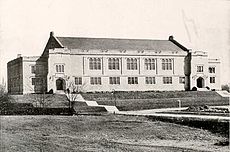
The Men's Gymnasium hosted Hoosier basketball from 1917–1928 and was the first in the nation to use glass backboards.
The Men's Gymnasium served as the home of the basketball team from 1917–1928. After the first few games spectators complained that they couldn't see the game because of opaque wooden backboards. As a result, the Nurre Mirror Plate Company in Bloomington was employed to create new backboards that contained one-and-a-half inch thick plate glass so that fans could see games without an obstructed view. As a result, it was the first facility in the country to use glass backboards.[45] Due to growing popularity of the sport at the school the team eventually had to move to a larger arena. The facility is now used by the School of Public Health-Bloomington (formerly the School of Health, Physical Education, and Recreation, HPER).
Wildermuth Intramural Center (1928–1960)
The Wildermuth Intramural Center (previously called The Fieldhouse) hosted the basketball team from 1928–1960. Indiana star player (and later coach) Branch McCracken scored the first point in the facility with a free throw.[19] During the team's 32 seasons there, it hosted two national championship teams, five conference titles, twenty different All-Americans, and three Big Ten Most Valuable Players. However, the growing popularity of the sport necessitated a move to a new facility.
Gladstein Fieldhouse (1960–1971)
The New Fieldhouse (later named the Gladstein Fieldhouse) was originally intended as an interim home for the men's basketball team, but ended up hosting the team for eleven years from 1960–1971. It now serves as a state-of-the-art track and field facility.
Simon Skjodt Assembly Hall (1971–present)
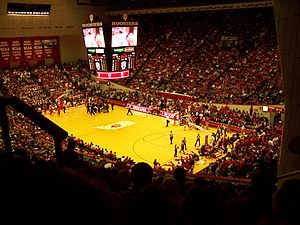
An interior view of Assembly Hall's Branch McCracken Court.
The Hoosiers currently play at Simon Skjodt Assembly Hall. The 17,222 seat arena has been the home of the men's basketball team since 1972. The basketball floor is named Branch McCracken Court after the legendary Hoosier coach. The north end of the arena prominently displays the program's five national championship banners. Former head coach Bob Knight called the facility a "sacred place" for student fans and athletes.[46] Basketball sportscaster Gus Johnson called Assembly Hall, "the Carnegie Hall of basketball."[47]
Cook Hall (2010–present)
Cook Hall is a basketball practice facility that was completed in 2010 and is located next to Simon Skjodt Assembly Hall, connected by an underground tunnel. Bill and Gayle Cook donated $15 million to the "For the Glory of Old IU" campaign, out of which came Cook Hall where the IU basketball team is able to engage in day-to-day operations. It contains the Pfau Shine Legacy Court, a museum space that chronicles the history of Indiana basketball with photographs, artifacts, trophies and interactive touch-screen kiosks. The 67,000-square-foot, three story facility features two practice courts, two locker rooms, two player lounges, a strength and conditioning area, coaches' offices, and meeting rooms.[48]
Coaching history
Years | Duration of head coaching career at Indiana |
Win-Loss | Number of career games won-loss at Indiana |
Win% | Percentage of games won at Indiana |
| * | Elected to the Naismith Memorial Basketball Hall of Fame as a coach |
| Coach | Years | Win–Loss | Win % | Conference titles | NCAA Tourn. appearances | NCAA titles |
|---|---|---|---|---|---|---|
| James H. Horne | 1901 | 1–4 | .200 | 0 | – | – |
| Phelps Darby | 1902 | 4–4 | .500 | 0 | – | – |
| Willis Coval | 1903–1904 | 13–8 | .619 | 0 | – | – |
| Z. G. Clevenger | 1905–1906 | 12–21 | .364 | 0 | – | – |
| James M. Sheldon | 1907 | 9–5 | .643 | 0 | – | – |
| Ed Cook | 1908 | 9–6 | .600 | 0 | – | - |
| Robert Harris | 1909 | 5–9 | .357 | 0 | – | – |
| John Georgen | 1910 | 5–8 | .385 | 0 | – | – |
| Oscar Rackle | 1911 | 11–5 | .688 | 0 | – | – |
| James Kase | 1912 | 6–11 | .353 | 0 | – | – |
| Arthur Powell | 1913 | 5–11 | .312 | 0 | – | – |
| Arthur Berndt | 1914–1915 | 6–21 | .222 | 0 | – | – |
| Allan Williford | 1916 | 6–7 | .462 | 0 | – | – |
| Guy Lowman | 1917 | 13–6 | .684 | 0 | – | – |
| Dana Evans | 1918–1919 | 20–11 | .645 | 0 | – | – |
| Ewald O. Stiehm | 1920 | 13–8 | .619 | 0 | – | – |
| George Levis | 1921–1922 | 25–16 | .610 | 0 | – | – |
| Leslie Mann | 1922–1924 | 19–13 | .594 | 0 | – | – |
Everett Dean* | 1924–1938 | 162–93 | .635 | 3 | – | – |
Branch McCracken* | 1938–1943, 1946–1965 | 364–174 | .677 | 4 | 4 | 2 |
| Harry C. Good | 1943–1946 | 35–29 | .547 | 0 | 0 | 0 |
| Lou Watson | 1965–1971 | 65–60 | .520 | 1 | 1 | 0 |
| Jerry Oliver | 1969–1970, 1971 | 4–17 | .190 | 0 | 0 | 0 |
Bob Knight* | 1971–2000 | 662–239 | .735 | 11 | 24 | 3 |
| Mike Davis | 2000–2006 | 115–79 | .592 | 1 | 4 | 0 |
| Kelvin Sampson | 2006–2008 | 43–15 | .741 | 0 | 1 | 0 |
| Dan Dakich | 2008 | 3–4 | .429 | 0 | 1 | 0 |
| Tom Crean | 2008–2017 | 166–135 | .552 | 2 | 4 | 0 |
| Archie Miller | 2017–Current | 22–17 | .564 | 0 | 0 | 0 |
Notable players and coaches
1,000-point scorers
The Hoosiers currently have 51 players in their 1,000-point club.[49]
Calbert Cheaney is the all-time leading scorer at Indiana University with 2,613 points.[50] Cheaney was able to reach the 1,000-point milestone in just 53 games, the 4th quickest Hoosier to do so. Others of honorable mention include Don Schlundt (43 games), Archie Dees (47 games), Walt Bellamy (50 games), Mike Woodson and Jimmy Rayl (54 games), Joe Cooke and Jay Edwards (55 games), Bracey Wright (59 games), and rounding out the top 10 is Tom Bolyard (60 games).[49]

Walt Bellamy scored 1,441 points.

Jordan Hulls scored 1,318 points.
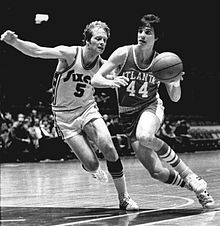
Tom Van Arsdale (left) scored 1,252 points.

Jared Jeffries scored 1,008 points.
| Rank | Player name | Points | Seasons played |
|---|---|---|---|
| 1 | Calbert Cheaney | 2,613 | 1989–93 |
| 2 | Steve Alford | 2,438 | 1983–87 |
| 3 | Don Schlundt | 2,192 | 1951–55 |
| 4 | A. J. Guyton | 2,100 | 1996–00 |
| 5 | Mike Woodson | 2,061 | 1976–80 |
| 6 | Yogi Ferrell | 1,986 | 2012–16 |
| 7 | Alan Henderson | 1,979 | 1991–95 |
| 8 | Damon Bailey | 1,741 | 1990–94 |
| 9 | Kent Benson | 1,740 | 1973–77 |
| 10 | Christian Watford | 1,730 | 2009–13 |
| 11 | Eric Anderson | 1,715 | 1988–92 |
| 12 | Brian Evans | 1,701 | 1992–96 |
| 13 | Scott May | 1,593 | 1972–76 |
| 14 | Greg Graham | 1,590 | 1989–93 |
| 15 | Randy Wittman | 1,549 | 1978–83 |
| 16 | Archie Dees | 1,546 | 1955–58 |
| 17 | Bracey Wright | 1,498 | 2002–05 |
| 18 | D. J. White | 1,447 | 2004–08 |
| 19 | Walt Bellamy | 1,441 | 1958–61 |
| 20 | Ray Tolbert | 1,427 | 1977–81 |
| 21 | Robert Johnson | 1,413 | 2014–18 |
| 22 | Kirk Haston | 1,406 | 1998-01 |
| 23 | Jimmy Rayl | 1,401 | 1960–63 |
| 24 | Andrae Patterson | 1,365 | 1994–98 |
| 25 | Uwe Blab | 1,357 | 1981–85 |
| 26 | Verdell Jones III | 1,347 | 2009–12 |
| 27 | Ted Kitchel | 1,336 | 1978–83 |
| 28 | Jordan Hulls | 1,318 | 2009–13 |
| 29 | Tom Bolyard | 1,299 | 1960–63 |
| 30 | Joby Wright | 1,272 | 1969–72 |
| 31 | Steve Green | 1,265 | 1972–75 |
| 32 | James Blackmon Jr. | 1,257 | 2014–17 |
| 33 | Tom Van Arsdale | 1,252 | 1962–65 |
| 34 | Dick Van Arsdale | 1,240 | 1962–65 |
| 35 | Steve Downing | 1,220 | 1970–73 |
| 36 | Tom Coverdale | 1,217 | 1999-03 |
| 37 | Jeff Netwon | 1,203 | 1999-03 |
| 38 | Quinn Buckner | 1,195 | 1972–76 |
| 39 | Cody Zeller | 1,157 | 2011–13 |
| 40 | Will Sheehey | 1,120 | 2010–14 |
| 41 | Victor Oladipo | 1,117 | 2010–13 |
| 42 | Troy Williams | 1,115 | 2013–16 |
| 43 | Marshall Strickland | 1,106 | 2002–06 |
| 44 | Vernon Payne | 1,101 | 1965–68 |
| 45 | Joe Cooke | 1,099 | 1967–70 |
| 46 | Bobby Leonard | 1,098 | 1951–54 |
| 47 | Daryl Thomas | 1,095 | 1983–87 |
| 48 | Rick Calloway | 1,073 | 1985–88 |
| 49 | Jay Edwards | 1,038 | 1987–89 |
| 50 | Butch Joyner | 1,030 | 1965–68 |
| 51 | Jared Jeffries | 1,008 | 2000–02 |
National Players of the Year
Kent Benson – 1976 (Helms Foundation)
Scott May – 1976 (Naismith, Helms Foundation, Sporting News, NABC, Associated Press, UPI)
Calbert Cheaney – 1993 (Wooden, Naismith, Sporting News, Oscar Robertson, NABC, Associated Press, UPI)
Victor Oladipo – 2013 (Sporting News)
All-Americans
Indiana has a total of 45 players who have claimed All-American status, with 13 of them earning First-Team All-American.
|
|
|
♦ Denotes Consensus First-Team All-American
Academic All-Americans
A total of 11 Hoosiers have been deemed Academic All-Americans.
|
|
|
McDonald's All-Americans
Indiana has recruited a total of 30 McDonald's All-Americans; the first coming in 1977 and the latest in 2018.
|
|
|
Indiana Mr. Basketballs
27 Indiana Mr. Basketball honorees have played for Indiana.
|
|
|
Coaching honors
National Coach of the Year
| Big Ten Coach of the Year
|
Big Ten Conference honors
Big Ten Player of the Year
| Big Ten Freshman of the Year
|
Naismith Memorial Basketball Hall of Famers
Branch McCracken, inducted in 1960 as a player
Everett Dean, inducted in 1966 as a coach
Bob Knight, inducted in 1991 as a coach
Walt Bellamy, inducted in 1993 as a player
Isiah Thomas, inducted in 2000 as a player
Bobby "Slick" Leonard, inducted in 2014 as a coach
George McGinnis, inducted in 2017 as a player
National Collegiate Basketball Hall of Famers
Everett Dean, inducted in 2006 as a coach
Branch McCracken, inducted in 2006 as a player
Bob Knight, inducted in 2006 as a coach
Isiah Thomas, inducted in 2006 as a player
Walt Bellamy, inducted in 2006 as a player
Quinn Buckner, inducted in 2015 as a player
Scott May, inducted in 2017 as a player
Current NBA players
Eric Gordon (Houston Rockets)
Victor Oladipo (Indiana Pacers)
Cody Zeller (Charlotte Hornets)
Noah Vonleh (New York Knicks)
Yogi Ferrell (Sacramento Kings)
Troy Williams (Sacramento Kings)
Thomas Bryant (Washington Wizards)
OG Anunoby (Toronto Raptors)
Olympians
| Year | City | Olympian | Medal |
|---|---|---|---|
| 1960 | Rome | Walt Bellamy |  |
| 1976 | Montreal | Quinn Buckner | |
| 1976 | Montreal | Scott May | |
| 1984 | Los Angeles | Bobby Knight | |
| 1984 | Los Angeles | Steve Alford | |
School records
Conferences
| Years | Conferences | Win–Loss | Pct. |
|---|---|---|---|
| 1899–1917 | Big Nine | 105–126 | .455 |
| 1918–1945 | Big Ten | 343–184 | .651 |
| 1946–1950 | Big Nine | 69–36 | .657 |
| 1951–present | Big Ten | 1,306–670 | .661 |
Record vs. Big Ten opponents
The IU Hoosiers lead the all-time series vs. all other Big Ten opponents, excluding instate-rival, Purdue.
| Opponent | Wins | Losses | Pct. | Streak |
|---|---|---|---|---|
Illinois | 91 | 87 | .511 | Indiana 1 |
Iowa | 102 | 75 | .576 | Indiana 3 |
Maryland | 8 | 5 | .615 | Indiana 1 |
Michigan | 107 | 60 | .641 | Michigan 4 |
Michigan State | 68 | 55 | .553 | Michigan State 2 |
Minnesota | 101 | 68 | .598 | Indiana 2 |
Nebraska | 12 | 6 | .667 | Nebraska 2 |
Northwestern | 117 | 51 | .696 | Indiana 3 |
Ohio State | 107 | 83 | .563 | Ohio State 2 |
Penn State | 38 | 11 | .776 | Indiana 3 |
Purdue | 89 | 118 | .430 | Purdue 3 |
Rutgers | 6 | 1 | .857 | Rutgers 1 |
Wisconsin | 96 | 74 | .565 | Wisconsin 5 |
Updated March 2, 2018
Team season records
| Record | Total | Year |
|---|---|---|
| Field Goals Made | 1,148 | 1974–1975 |
| Field Goals % | 53.7 | 1985–1986 |
| Free Throws Made | 760 | 2002–2003 |
| Free Throw % | 76.8 | 1964–1965 |
| 3-pt. Field Goals Made | 345 | 2015–2016 |
| 3-pt. Field Goal % | 50.8 | 1986–1987 |
| Rebounds | 1,433 | 1974–1975 |
| Assists | 655 | 1975–1976 |
| Blocked Shots | 192 | 2001–2002 |
Individual career
| Record | Player | Total | Years | Ref |
|---|---|---|---|---|
| Most Points | Calbert Cheaney | 2,613 | 1989–1993 | [52] |
| Highest Scoring Average | George McGinnis | 29.9 | 1970–1971 | |
| Most Rebounds | Alan Henderson | 1,091 | 1991–1995 | |
| Most Assists | Yogi Ferrell | 633 | 2012–2016 |
Career leaders
- Updated through 2017–18 season
| Player | Years | Points |
|---|---|---|
| Calbert Cheaney | 1989–1993 | 2,613 |
| Steve Alford | 1983–1987 | 2,438 |
| Don Schlundt | 1951–1955 | 2,192 |
| A.J. Guyton | 1996–2000 | 2,100 |
| Mike Woodson | 1976–1980 | 2,061 |
| Yogi Ferrell | 2012–2016 | 1,986 |
| Alan Henderson | 1991–1995 | 1,979 |
| Damon Bailey | 1990–1994 | 1,741 |
| Kent Benson | 1973–1977 | 1,740 |
| Christian Watford | 2009–2013 | 1,730 |
| Player | Years | Rebounds |
|---|---|---|
| Alan Henderson | 1991–1995 | 1,091 |
| Walt Bellamy | 1958–1961 | 1,087 |
| Kent Benson | 1973–1977 | 1,031 |
| Archie Dees | 1955–1958 | 914 |
| Steve Downing | 1970–1973 | 889 |
| Ray Tolbert | 1977–1981 | 874 |
| Don Schlundt | 1951–1955 | 860 |
| Eric Anderson | 1988–1992 | 825 |
| Christian Watford | 2009–2013 | 776 |
| Brian Evans | 1992–1996 | 750 |
| Player | Years | Assists |
|---|---|---|
| Yogi Ferrell | 2012–2016 | 633 |
| Michael Lewis | 1996–2000 | 545 |
| Quinn Buckner | 1972–1976 | 542 |
| Tom Coverdale | 1999–2003 | 500 |
| Jamal Meeks | 1988–1992 | 474 |
| Damon Bailey | 1990–1994 | 474 |
| Randy Wittman | 1978–1983 | 432 |
| A.J. Guyton | 1996–2000 | 403 |
| Stew Robinson | 1982–1986 | 391 |
| Verdell Jones III | 2008–2012 | 389 |
Postseason appearances
Indiana has won five NCAA Championships in men's basketball (1940, 1953, 1976, 1981, 1987) — the first two under coach Branch McCracken and the latter three under Bob Knight — and 22 Big Ten Conference championships. The Hoosiers' five NCAA Championships are tied with Duke (5) for the fourth-most in history, trailing only UCLA (11), Kentucky (8), and North Carolina (6).[53] Their eight trips to the Final Four ranks eighth on the all-time list.[54] The Hoosiers have made 39 appearances in the NCAA Men's Division I Basketball Tournament (sixth-most in NCAA history).[53] In those 39 appearances, Indiana has posted a 66–34 record (.660).[53] Its 66 victories are the sixth-most in NCAA history.[53] The Hoosiers are ranked 8th for the longest streak of NCAA tournament appearances at 18 (1986–2003). The Hoosiers also won post-season tournaments in 1974, the Collegiate Commissioners Association Tournament, and in 1979, the National Invitation Tournament. As of 2018, the 1976 Hoosiers remain the last NCAA men's basketball team to go undefeated in both regular season and postseason play.
NCAA Tournament
Championship Results
National Championships | ||||
|---|---|---|---|---|
Indiana University NCAA Basketball Champions 1940 | Indiana University NCAA Basketball Champions 1953 | Indiana University NCAA Basketball Champions 1976 | Indiana University NCAA Basketball Champions 1981 | Indiana University NCAA Basketball Champions 1987 |
| Round | Opponent | Score |
|---|---|---|
| Regional Semifinals | Springfield | 48–24 |
| Regional Finals | Duquesne | 39–30 |
| National Finals | Kansas | 60–42 |
| Round | Opponent | Score |
|---|---|---|
| Regional Semifinals | DePaul | 82–80 |
| Regional Finals | Notre Dame | 79–66 |
| National Semifinals | LSU | 80–67 |
| National Finals | Kansas | 69–68 |
| Round | Opponent | Score |
|---|---|---|
| Round #2 | St. John's | 90–70 |
| Regional Semifinals | Alabama | 74–69 |
| Regional Finals | Marquette | 65–56 |
| National Semifinals | UCLA | 65–51 |
| National Finals | Michigan | 86–68 |
| Round | Opponent | Score |
|---|---|---|
| Round #2 | # 6 Maryland | 99–64 |
| Regional Semifinals | #7 UAB | 87–72 |
| Regional Finals | #9 St. Joseph's | 78–46 |
| National Semifinals | #1 LSU | 95–84 |
| National Finals | #2 North Carolina | 63–50 |
| Round | Opponent | Score |
|---|---|---|
| Round #1 | #16 Fairfield | 92–58 |
| Round #2 | #8 Auburn | 107–90 |
| Regional Semifinals | #5 Duke | 88–82 |
| Regional Finals | #10 LSU | 77–76 |
| National Semifinals | #1 UNLV | 97–93 |
| National Finals | #2 Syracuse | 74–73 |
NCAA Men's MOP Award[60]
1940 – Marvin Huffman
1976 – Kent Benson
1981 – Isiah Thomas
1987 – Keith Smart
NCAA Tournament seeding history
The NCAA began seeding the tournament with the 1979 edition.
| Years → | '80 | '81 | '82 | '83 | '84 | '86 | '87 | '88 | '89 | '90 | '91 | '92 | '93 | '94 | '95 | '96 | '97 | '98 | '99 |
|---|---|---|---|---|---|---|---|---|---|---|---|---|---|---|---|---|---|---|---|
Seeds → | 2 | 3 | 5 | 2 | 5 | 3 | 1 | 4 | 2 | 8 | 2 | 2 | 1 | 5 | 9 | 6 | 8 | 7 | 6 |
| Years → | '00 | '01 | '02 | '03 | '06 | '07 | '08 | '12 | '13 | '15 | '16 |
|---|---|---|---|---|---|---|---|---|---|---|---|
Seeds → | 6 | 4 | 5 | 7 | 6 | 7 | 8 | 4 | 1 | 10 | 5 |
[18]
Complete NCAA Tournament results
The Hoosiers have appeared in the NCAA Tournament 39 times. Their combined record is 66–34.
| Year | Seed | Round | Opponent | Results |
|---|---|---|---|---|
| 1940 | Elite Eight Final Four National Championship Game | Springfield Duquesne Kansas | W 48–24 W 39–30 W 60–42 | |
| 1953 | Sweet Sixteen Elite Eight Final Four National Championship Game | DePaul Notre Dame LSU Kansas | W 82–80 W 79–66 W 80–67 W 69–68 | |
| 1954 | Sweet Sixteen Regional 3rd Place Game | Notre Dame LSU | L 64–65 W 73–62 | |
| 1958 | Sweet Sixteen Regional 3rd Place Game | Notre Dame Miami (OH) | L 87–94 W 98–91 | |
| 1967 | Sweet Sixteen Regional 3rd Place Game | Virginia Tech Tennessee | L 70–79 W 51–44 | |
| 1973 | Sweet Sixteen Elite Eight Final Four National 3rd Place Game | Marquette Kentucky UCLA Providence | W 75–69 W 72–65 L 59–70 W 97–79 | |
| 1975 | First Round Sweet Sixteen Elite Eight | UTEP Oregon State Kentucky | W 78–53 W 81–71 L 90–92 | |
| 1976 | First Round Sweet Sixteen Elite Eight Final Four National Championship Game | St. John's Alabama Marquette UCLA Michigan | W 90–70 W 74–69 W 65–56 W 65–51 W 86–68 | |
| 1978 | First Round Sweet Sixteen | Furman Villanova | W 63–62 L 60–61 | |
| 1980 | #2 | Second Round Sweet Sixteen | #7 Virginia Tech #6 Purdue | W 68–59 L 69–76 |
| 1981 | #3 | Second Round Sweet Sixteen Elite Eight Final Four National Championship Game | #6 Maryland #7 UAB #9 Saint Joseph's #1 LSU #2 North Carolina | W 99–64 W 87–72 W 78–46 W 67–49 W 63–50 |
| 1982 | #5 | First Round Second Round | #12 Robert Morris #4 UAB | W 94–62 L 70–80 |
| 1983 | #2 | Second Round Sweet Sixteen | #7 Oklahoma #3 Kentucky | W 63–49 L 59–64 |
| 1984 | #4 | Second Round Sweet Sixteen Elite Eight | #12 Richmond #1 North Carolina #7 Virginia | W 75–67 W 72–68 L 48–50 |
| 1986 | #3 | First Round | #13 Cleveland State | L 79–83 |
| 1987 | #1 | First Round Second Round Sweet Sixteen Elite Eight Final Four National Championship Game | #16 Fairfield #8 Auburn #5 Duke #10 LSU #1 UNLV #2 Syracuse | W 92–58 W 107–90 W 88–82 W 77–76 W 97–93 W 74–73 |
| 1988 | #4 | First Round | #13 Richmond | L 69–72 |
| 1989 | #2 | First Round Second Round Sweet Sixteen | #15 George Mason #7 UTEP #3 Seton Hall | W 99–85 W 92–69 L 65–78 |
| 1990 | #8 | First Round | #9 California | L 63–65 |
| 1991 | #2 | First Round Second Round Sweet Sixteen | #15 Coastal Carolina #7 Florida State #3 Kansas | W 79–69 W 82–60 L 65–83 |
| 1992 | #2 | First Round Second Round Sweet Sixteen Elite Eight Final Four | #15 Eastern Illinois #7 LSU #3 Florida State #1 UCLA #1 Duke | W 94–55 W 89–79 W 85–74 W 106–79 L 78–81 |
| 1993 | #1 | First Round Second Round Sweet Sixteen Elite Eight | #16 Wright State #9 Xavier #4 Louisville #2 Kansas | W 97–54 W 73–70 W 82–69 L 77–83 |
| 1994 | #5 | First Round Second Round Sweet Sixteen | #12 Ohio #4 Temple #9 Boston College | W 84–72 W 67–58 L 68–77 |
| 1995 | #9 | First Round | #8 Missouri | L 60–65 |
| 1996 | #6 | First Round | #11 Boston College | L 51–64 |
| 1997 | #8 | First Round | #9 Colorado | L 62–80 |
| 1998 | #7 | First Round Second Round | #10 Oklahoma #2 Connecticut | W 94–87 OT L 68–78 |
| 1999 | #6 | First Round Second Round | #11 George Washington #3 St. John's | W 108–88 L 61–86 |
| 2000 | #6 | First Round | #11 Pepperdine | L 57–77 |
| 2001 | #4 | First Round | #13 Kent State | L 73–77 |
| 2002 | #5 | First Round Second Round Sweet Sixteen Elite Eight Final Four National Championship Game | #12 Utah #13 UNC Wilmington #1 Duke #10 Kent State #2 Oklahoma #1 Maryland | W 75–56 W 76–67 W 74–73 W 81–69 W 73–64 L 52–64 |
| 2003 | #7 | First Round Second Round | #10 Alabama #2 Pittsburgh | W 67–62 L 52–74 |
| 2006 | #6 | First Round Second Round | #11 San Diego State #3 Gonzaga | W 87–83 L 80–90 |
| 2007 | #7 | First Round Second Round | #10 Gonzaga #2 UCLA | W 70–57 L 49–54 |
| 2008 | #8 | First Round | #9 Arkansas | L 72–86 |
| 2012 | #4 | Second Round Third Round Sweet Sixteen | #13 New Mexico State #12 VCU #1 Kentucky | W 79–66 W 63–61 L 90–102 |
| 2013 | #1 | Second Round Third Round Sweet Sixteen | #16 James Madison #9 Temple #4 Syracuse | W 83–62 W 58–52 L 50–61 |
| 2015 | #10 | Second Round | #7 Wichita State | L 76–81 |
| 2016 | #5 | First Round Second Round Sweet Sixteen | #12 Chattanooga #4 Kentucky #1 North Carolina | W 99–74 W 73–67 L 86–101 |
NIT Results
The Hoosiers have appeared in the National Invitation Tournament (NIT) five times. Their combined record is 8–4. They were NIT champions in 1979.
| Year | Round | Opponent | Result |
|---|---|---|---|
| 1972 | First Round | Princeton | L 60–68 |
| 1979 | First Round Second Round Semifinals Finals | Texas Tech Alcorn State Ohio State Purdue | W 78–59 W 72–68 W 64–55 W 53–52 |
| 1985 | First Round Second Round Quarterfinals Semifinals Finals | Butler Richmond Marquette Tennessee UCLA | W 79–57 W 75–53 W 94–82 W 74–67 L 62–65 |
| 2005 | First Round | Vanderbilt | L 60–67 |
| 2017 | First Round | Georgia Tech | L 63–75 |
CCAT Results
The Hoosiers appeared in one of the only two ever Collegiate Commissioners Association Tournaments. Their record is 3–0 and were champions in 1974.[18]
| Year | Round | Opponent | Result |
|---|---|---|---|
| 1974 | Quarterfinals Semifinals Finals | Tennessee Toledo USC | W 73–71 W 73–72 W 83–76 |
Big Ten regular-season championships
Indiana has won 22 Big Ten regular-season championships, the second-most in Big Ten history.
| ||||||||||||||||||||||||||||||||||||||||||||||||||||||||||||||||||||||||||||||||||||||||||||||||
Tournament Titles
| Season | Tournament | Results |
|---|---|---|
| 1939–40 | NCAA Championship | W vs. Springfield 48–24 W vs. Duquesne 39–30 W vs. Kansas 60–42 |
| 1952–53 | NCAA Championship | W vs. DePaul 82–80 W vs. Notre Dame 79–66 W vs. LSU 80–67 W vs. Kansas 69–68 |
| 1973–74 | CCAT | W vs. Tennessee 73–71 W vs. Toledo 73–7 W vs. USC 83–76 |
| 1975–76 | NCAA Championship | W vs. St. John's 90–70 W vs. Alabama 74–69 W vs. Marquette 65–56 W vs. UCLA 65–51 W vs. Michigan 86–68 |
| 1978–79 | NIT | W vs. Texas Tech 78–59 W vs. Alcorn State 72–68 W vs. Ohio State 64–55 W vs. Purdue 53–52 |
| 1980–81 | NCAA Championship | W vs. Maryland 99–64 W vs. UAB 87–72 W vs. St. Joseph's 78–46 W vs. LSU 67–49 W vs. North Carolina 63–50 |
| 1986–87 | NCAA Championship | W vs. Fairfield 92–58 W vs. Auburn 107–90 W vs. Duke 88–82 W vs. LSU 77–76 W vs. UNLV 97–93 W vs. Syracuse 74–73 |
| 2002–03 | Maui Invitational | W vs. UMass 84–71 W vs. Gonzaga 76–75 W vs. Virginia 70–63 |
| 2012–13 | Legends Classic | W vs. Georgia 66–53 W vs. Georgetown 82–72 |
Key Statistics
| Overall | |
|---|---|
| Years of basketball | 119 |
| First season | 1900–01 |
| Head coaches (all-time) | 29 |
| All Games | |
| All-time record | 1,823–1,036 (.638) |
| Home record | 561–112 (.834) |
| 20+ win seasons | 35 |
| 30+ win seasons | 4 |
| Conference Games | |
| Conference Record | 925-673 (.579) |
| Conference Regular Season Championships | 22 |
| Conference Tournament Championships | 0 |
| NCAA Tournament | |
| NCAA Appearances | 39 |
| NCAA Tournament wins | 66 |
| Sweet Sixteens | 22 |
| Elite Eights | 11 |
| Final Fours | 8 |
| Championship Games | 6 |
| Championships | 5 |
Accurate as of 3/2/2018. | |
Rankings
Indiana teams have spent a total of 54 weeks ranked number 1, most recently in 2013.
The Associated Press began its basketball poll on January 20, 1949. The following is a summary of those annual polls. Starting in the 1961-62 season, AP provided a preseason (PS) poll. AP did a post-tournament poll in 1953, 1954, 1974 and 1975. The following table summarizes Indiana history in the AP Poll:[61]
Year | Preseason | Peak | Final | Weeks ranked | Weeks @ #1 |
| Top 20 Poll | |||||
|---|---|---|---|---|---|
| 1949–50 | NA | 4 | 20 | 8/10 | 0 |
| 1950–51 | NA | 3 | 7 | 12/12 | 0 |
| 1951–52 | NA | 4 | NR | 10/13 | 0 |
| 1952–53 | NA | 1 | 1 | 14/14 | 3 |
| 1953–54 | NA | 1 | 4 | 15/15 | 3 |
| 1954–55 | NA | 6 | NR | 2/14 | 0 |
| 1955–56 | NA | 12 | NR | 4/15 | 0 |
| 1956–57 | NA | 10 | NR | 3/14 | 0 |
| 1957–58 | NA | 12 | 12 | 1/14 | 0 |
| 1958–59 | NA | 15 | NR | 4/14 | 0 |
| 1959–60 | NA | 7 | 7 | 6/12 | 0 |
| 1960–61 | NA | 4 | NR | 3/13 | 0 |
| Top 10 Poll | |||||
| 1962–63 | NR | 8 | NR | 1/16 | 0 |
| 1964–65 | NR | 2 | NR | 10/15 | 0 |
| 1967–68 | NR | 3 | NR | 3/16 | 0 |
| Top 20 Poll | |||||
| 1970–71 | 16 | 11 | NR | 9/16 | 0 |
| 1971–72 | NR | 8 | 17 | 7/16 | 0 |
| 1972–73 | NR | 4 | 6 | 14/16 | 0 |
| 1973–74 | 3 | 3 | 9 | 18/18 | 0 |
| 1974–75 | 3 | 1 | 3 | 19/19 | 11 |
| 1975–76 | 1 | 1 | 1 | 17/17 | 17 |
| 1976–77 | 5 | 4 | NR | 4/17 | 0 |
| 1977–78 | NR | 11 | 13 | 4/17 | 0 |
| 1978–79 | 10 | 10 | NR | 2/17 | 0 |
| 1979–80 | 1 | 1 | 7 | 14/15 | 3 |
| 1980–81 | 5 | 5 | 9 | 12/16 | 0 |
| 1981–82 | 12 | 10 | NR | 7/16 | 0 |
| 1982–83 | 9 | 1 | 5 | 18/18 | 2 |
| 1983–84 | 19 | 17 | NR | 2/17 | 0 |
| 1984–85 | 4 | 4 | NR | 10/17 | 0 |
| 1985–86 | NR | 15 | 16 | 12/17 | 0 |
| 1986–87 | 3 | 2 | 3 | 16/16 | 0 |
| 1987–88 | 6 | 5 | NR | 9/17 | 0 |
| 1988–89 | NR | 3 | 8 | 10/18 | 0 |
| Top 25 Poll | |||||
| 1989–90 | 14 | 9 | NR | 13/17 | 0 |
| 1990–91 | 8 | 3 | 3 | 17/17 | 0 |
| 1991–92 | 2 | 2 | 5 | 18/18 | 0 |
| 1992–93 | 4 | 1 | 1 | 18/18 | 5 |
| 1993–94 | 12 | 8 | 18 | 18/18 | 0 |
| 1994–95 | 9 | 9 | NR | 4/18 | 0 |
| 1995–96 | 23 | 23 | NR | 2/18 | 0 |
| 1996–97 | NR | 8 | NR | 15/18 | 0 |
| 1997–98 | 17 | 17 | NR | 4/18 | 0 |
| 1998–99 | 22 | 8 | 19 | 18/18 | 0 |
| 1999–00 | NR | 9 | 22 | 15/18 | 0 |
| 2000–01 | NR | 20 | 20 | 1/18 | 0 |
| 2001–02 | 22 | 20 | NR | 8/18 | 0 |
| 2002–03 | 21 | 6 | NR | 12/19 | 0 |
| 2005–06 | 24 | 9 | NR | 14/19 | 0 |
| 2006–07 | NR | 23 | NR | 2/19 | 0 |
| 2007–08 | 9 | 7 | NR | 19/20 | 0 |
| 2011–12 | NR | 7 | 16 | 14/19 | 0 |
| 2012–13 | 1 | 1 | 4 | 19/19 | 10 |
| 2014–15 | NR | 22 | NR | 2/19 | 0 |
| 2015–16 | 15 | 10 | 14 | 12/19 | 0 |
| 2016–17 | 11 | 3 | NR | 9/19 | 0 |
Victories over AP number 1 teams
Indiana has seven victories over the AP number one ranked team, including the 2011 Kentucky upset.[62]
- Mar. 22, 1984 – NR IU 73, No. 1 North Carolina 68
- Mar. 28, 1987 – No. 3 IU 97, No. 1 UNLV 93
- Dec. 4, 1993 – No. 11 IU 96, No. 1 Kentucky, 84
- Jan. 7, 2001 – NR IU 59, No. 1 Michigan State 58
- Mar. 21, 2002 – NR IU 74, No. 1 Duke 73
- Dec. 10, 2011 – NR IU 73, No. 1 Kentucky 72
- Feb. 2, 2013 – No. 3 IU 81, No. 1 Michigan 73
Radio network affiliates
| City | Call Sign | Frequency |
|---|---|---|
| Batesville, Indiana | WRBI-FM | 103.9 |
| Bedford, Indiana | WQRK-FM | 105.5 |
| Bloomington, Indiana | WHCC-FM | 105.1 |
| Boonville, Indiana | WBNL-AM | 1540 |
| Columbus, Indiana | WXCH-FM | 102.9 |
| Evansville, Indiana | WEOA-AM/FM | 1400/98.5 |
| Fort Wayne, Indiana | WGL-AM/FM | 1250/102.9 |
| French Lick, Indiana | WFLQ-FM | 100.1 |
| Hammond, Indiana | WJOB-AM | 1230 |
| Indianapolis, Indiana | WFNI-AM/FM | 1070/107.5 |
| Indianapolis, Indiana | WIBC-FM | 93.1 |
| Jasper, Indiana | WITZ-FM | 104.7 |
Jeffersonville, Indiana/Louisville, Kentucky | WXVW-AM | 1450 |
| Kendallville, Indiana | WAWK-AM/FM | 1140/95.5 |
| Kokomo, Indiana | WIOU-AM | 1350 |
| Ligonier, Indiana | WAOR-FM | 102.7 |
| Linton, Indiana | WQTY-FM | 93.3 |
| Loogootee, Indiana | WRZR-FM | 94.5 |
| Madison, Indiana | WXGO/WORX-AM/FM | 1270/96.7 |
| Marion, Indiana | WBAT-AM | 1400 |
| Michigan City, Indiana | WEFM-FM | 95.9 |
| Mount Vernon, Indiana | WYFX-FM | 106.7 |
| Portland, Indiana | WPGW/WPGW-AM/FM | 1440/100.9 |
| Richmond, Indiana | WHON-AM/FM | 930/101.7 |
| Richmond, Indiana | WQLK-FM | 96.1 |
Rockville, Indiana/Terre Haute, Indiana | WAXI-FM | 104.9 |
| Salem, Indiana | WSLM/WSLM-AM/FM | 1220/97.9 |
| Seymour, Indiana | WXKU-FM | 92.7 |
| South Bend, Indiana | WHME-FM | 103.1 |
| South Bend, Indiana | WHME-FM | 103.1 |
| Tell City, Indiana | WTCJ-AM/FM | 1230/91.5 |
| Vincennes, Indiana | WAOV/WZDM-AM/FM | 1450/92.1 |
| Reference:[63] | ||
See also
- NCAA Division I Men's Basketball Tournament records
- NCAA Men's Division I Final Four appearances by coaches
- NCAA Men's Division I Final Four appearances by school
- NCAA Men's Division I Basketball Tournament Consecutive Appearances
- NCAA Men's Division I Basketball Tournament all-time team records
References
^ Primary Colors (PDF). Indiana University Athletics Brand and Uniform Guidelines. August 28, 2018. Retrieved November 28, 2018..mw-parser-output cite.citationfont-style:inherit.mw-parser-output qquotes:"""""""'""'".mw-parser-output code.cs1-codecolor:inherit;background:inherit;border:inherit;padding:inherit.mw-parser-output .cs1-lock-free abackground:url("//upload.wikimedia.org/wikipedia/commons/thumb/6/65/Lock-green.svg/9px-Lock-green.svg.png")no-repeat;background-position:right .1em center.mw-parser-output .cs1-lock-limited a,.mw-parser-output .cs1-lock-registration abackground:url("//upload.wikimedia.org/wikipedia/commons/thumb/d/d6/Lock-gray-alt-2.svg/9px-Lock-gray-alt-2.svg.png")no-repeat;background-position:right .1em center.mw-parser-output .cs1-lock-subscription abackground:url("//upload.wikimedia.org/wikipedia/commons/thumb/a/aa/Lock-red-alt-2.svg/9px-Lock-red-alt-2.svg.png")no-repeat;background-position:right .1em center.mw-parser-output .cs1-subscription,.mw-parser-output .cs1-registrationcolor:#555.mw-parser-output .cs1-subscription span,.mw-parser-output .cs1-registration spanborder-bottom:1px dotted;cursor:help.mw-parser-output .cs1-hidden-errordisplay:none;font-size:100%.mw-parser-output .cs1-visible-errorfont-size:100%.mw-parser-output .cs1-subscription,.mw-parser-output .cs1-registration,.mw-parser-output .cs1-formatfont-size:95%.mw-parser-output .cs1-kern-left,.mw-parser-output .cs1-kern-wl-leftpadding-left:0.2em.mw-parser-output .cs1-kern-right,.mw-parser-output .cs1-kern-wl-rightpadding-right:0.2em
^ "Indiana's undefeated season would surpass Kentucky's". Chicago Tribune. 2015-03-07. Retrieved 2015-07-03.
^ "Top 16 college basketball teams of all time". CBS Sports. 2012-03-21. Retrieved 2015-07-03.
^ "1975–76 Undefeated Indiana team voted best-ever". USA Today. 2013-04-06. Retrieved 2015-07-03.
^ "BOZICH: 1976 Indiana Hoosiers Honored As NCAA's Top Team". WDRB. 2013-04-05. Retrieved 2015-07-03.
^ Indiana Basketball Game Notes, retrieved 20 March 2012.
^ "Total AP Men's BB Poll Appearances Summary - College Poll Archive - Historical College Football and Basketball Polls and Rankings". www.collegepollarchive.com.
^ IU game notes
^ Bozich, Alex (2 April 2018). "Study: IU basketball is nation's second most valuable program". Retrieved 2 April 2018.
^ "NCAA men's basketball attendance history" (PDF). ncaa.org. Archived from the original (PDF) on March 22, 2007. Retrieved 8 May 2007.
^ abc "The Tradition of Indiana's Candy Striped Warm Up Pants". YouTube. Retrieved 2 April 2012.
^ Rovell, Darren (4 April 2004). "The shirt off the players' backs". ESPN.com. Retrieved 2 April 2012.
^ Zillgitt, Jeff (1 April 2002). "'Hoosiers 2' in the making". USA Today. Retrieved 2 April 2012.
^ "IU fan wants school's colors to return to red". Courier & Press. 16 January 2011. Retrieved 2 April 2012.
^ ab Laskowski, John (2012). Tales from the Indiana Hoosiers Locker Room. Skyhorse Publishing Inc.
^ ab "The Tradition Of Martha The Mop Lady". YouTube. Retrieved 2 April 2012.
^ Bozich, Alex (10 November 2010). "Martha the "Mop Lady" is coming back". Inside the Hall. Retrieved 2 April 2012.
^ abcdefghijkl "Indiana University basketball history" (PDF). iuhoosiers.com. Retrieved 30 March 2008.
^ ab Hiner, Jason (2005). Indiana University Basketball Encyclopedia. United States: Sports Publishing. p. 448. ISBN 1-58261-655-8.
^ abcd Hammel, Bob (2006-03-01). "1940 Championship Team". heraldtimesonline.com. Retrieved 2008-03-30.
^ ab Spegele, Brian (22 February 2008). "History repeats itself: Violations reminiscent of 1960 scandal". Indiana Daily Student. Archived from the original on 11 December 2010. Retrieved 9 April 2012.
^ Dorr, Dave (1976-04-10). "A perfect season". sportingnews.com. Archived from the original on 2000-02-29. Retrieved 2008-03-28.
^ "Hoosier Historia". heraldtimesonline.com. Retrieved 28 March 2008.
^ Weinberg, Rick. "60: Smart's jumper wins NCAA title for Indiana". espn.com. Archived from the original on 2005-05-16. Retrieved 2008-03-30.
^ Katz, Andy. "Knight fired as Indiana head coach". espn.com. Retrieved 2009-03-09.
^ "Davis to Leave IU Basketball Program". iuhoosiers.com. Archived from the original on 15 June 2007. Retrieved 15 May 2007.
^ "Sampson Named Hoosiers' Head Coach". iuhoosiers.com. Archived from the original on 15 June 2007. Retrieved 15 May 2007.
^ Rabjohns, Jeff (2006-10-13). "Prep star Eric Gordon changes mind, makes move to Hoosiers". usatoday.com. Retrieved 2008-03-30.
^ Katz, Andy (2006-05-26). "Sampson barred from off-campus recruiting". espn.com. Retrieved 2008-03-30.
^ Katz, Andy (2008-02-23). "Indiana, Sampson reach $750,000 settlement to part ways". espn.com. Retrieved 2008-03-30.
^ "NCAA punishes Sampson; Indiana on probation". ESPN.com. 25 November 2008.
^ "2008 Coach search". cbs.sportsline.com. Archived from the original on 25 March 2008. Retrieved 28 March 2008.
^ ab Carpenter, Les. "Tom Crean pulled Indiana from unthinkable depths to the NCAA tournament in four arduous years". Yahoo Sports. Retrieved 20 March 2012.
^ "Indiana vs. Michigan State – Postgame Notes". iuhoosiers.com. 2012-02-28. Archived from the original on 2012-03-02. Retrieved 2012-03-04.
^ "Cody Zeller key as Indiana downs No. 5 Michigan State". espn.com. 2012-02-28. Retrieved 2012-03-04.
^ "Big Ten Men's Race is Sprint to the Finish".
^ "NCAA College Basketball Polls, College Basketball Rankings, NCAA Basketball Polls - ESPN". ESPN.com.
^ "Tom Crean fired by Indiana". SI.com. March 16, 2017. Retrieved March 16, 2017.
^ Matt norlander (2017-03-25). "College basketball coaching changes: Archie Miller leaves Dayton for Indiana; who will Flyers hire?". cbssports.com. Retrieved 2017-03-25.
^ https://247sports.com/college/indiana/Article/Transcript-Archie-Miller-at-IU-media-day-108128981
^ https://www.insidethehall.com/2018/04/10/thats-a-wrap-team-defense-6/
^ https://www.sbnation.com/college-basketball/2017/11/10/16636112/indiana-state-hoosiers-archie-miller-embarrassment-blowout
^ http://www.news-sentinel.com/news/local-news/2017/12/18/fort-wayne-mastodons-knock-off-iu-again/
^ Hiner, Jason (2005). Indiana University Basketball Encyclopedia. United States: Sports Publishing. p. 446. ISBN 1-58261-655-8.
^ Hiner, Jason (2005). Indiana University Basketball Encyclopedia. United States: Sports Publishing. p. 447. ISBN 1-58261-655-8.
^ "Bobby Knight speaks". Indianapolis Star. Retrieved 26 April 2012.
^ "Indiana's Assembly Hall". YouTube via IU Athletics. Retrieved 28 March 2012.
^ "2014–15 Indiana Hoosiers Record Book" (PDF). Indiana University Athletic Department. p. 11. Archived from the original on December 1, 2015.
^ ab "2014–15 Indiana Hoosiers Record Book" (PDF). Indiana University Athletic Department. pp. 148–149. Archived from the original on December 4, 2015.
^ "Who is Indiana's Division I all-time scoring leader". IndyStar. Retrieved December 4, 2015.
^ "Jim Strickland". Pro Basketball Encyclopedia. Retrieved August 24, 2016.
^ abcd "2014–15 Indiana Hoosiers Record Book" (PDF). Indiana University Athletic Department. pp. 150–180. Archived from the original on March 28, 2015.
^ abcd "All-time NCAA tourney win-loss records". cbs.sportsline.com. Archived from the original on 16 May 2008. Retrieved 31 March 2008.
^ "Tourney History – Seeds in the Final Four". cbs.sportsline.com. Archived from the original on 13 May 2008. Retrieved 31 March 2008.
^ "Indiana 1940 Championship Bracket". cbs.sportsline.com. Archived from the original on 3 February 2013. Retrieved 29 March 2008.
^ "Indiana 1953 Championship Bracket". cbs.sportsline.com. Archived from the original on 3 February 2013. Retrieved 29 March 2008.
^ "Indiana 1976 Championship Bracket". cbs.sportsline.com. Archived from the original on 3 February 2013. Retrieved 29 March 2008.
^ "Indiana 1981 Championship Bracket". cbs.sportsline.com. Archived from the original on 3 February 2013. Retrieved 29 March 2008.
^ "Indiana 1987 Championship Bracket". cbs.sportsline.com. Archived from the original on 11 April 2008. Retrieved 29 March 2008.
^ "Final Four Most Outstanding Players". cbs.sportsline.com. Archived from the original on 7 September 2008. Retrieved 31 March 2008.
^ "Division I Records" (PDF). National Collegiate Athletic Association. pp. 107–156. Retrieved July 13, 2018.
^ "2014–15 Indiana Hoosiers Record Book" (PDF). Indiana University Athletic Department. pp. 182–186. Archived from the original on December 3, 2015.
^ "Broadcast Information". IU Athletics. Retrieved July 16, 2018.
External links
Official website

Indiana University Bloomington | |||||||
|---|---|---|---|---|---|---|---|
Located in: Bloomington, Indiana | |||||||
| Academics |
|  | |||||
| Athletics |
| ||||||
| Campus |
| ||||||
| Student life |
| ||||||
| People |
| ||||||
| |||||||


