Riigikogu
Estonian Parliament Riigikogu | |
|---|---|
| XIII Riigikogu | |
 | |
| Type | |
| Type | Unicameral |
| History | |
| Founded | 23 April 1919 |
| Disbanded | suspended from 1940-1991 |
| Leadership | |
President of the Riigikogu | Eiki Nestor, (SDE) Since 20 March 2014 |
First Vice-President of the Riigikogu | Enn Eesmaa, (KE) Since 22 March 2018 |
Second Vice-President of the Riigikogu | Kalle Laanet, (RE) Since 22 March 2018 |
| Structure | |
| Seats | 101 (list) |
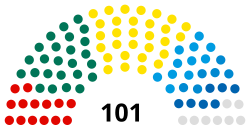 | |
Political groups | Government (50)
Opposition (51)
|
| Elections | |
Voting system | Party-list proportional representation Modified D'Hondt method |
Last election | 1 March 2015 |
Next election | 3 March 2019 |
| Meeting place | |
Toompea Castle, Tallinn | |
| Website | |
| www.riigikogu.ee | |
Estonia |
|---|
 |
This article is part of a series on the politics and government of Estonia |
State
|
Executive
|
Legislature
|
Judiciary
|
Elections
|
Administrative divisions
|
Foreign relations
|
|
The Riigikogu (Estonian pronunciation: [ˈriːgikogu]; from riigi-, of the state, and kogu, assembly) is the unicameral parliament of Estonia. All important state-related questions pass through the Riigikogu. In addition to approving legislation, the Riigikogu appoints high officials, including the Prime Minister and Chief Justice of the Supreme Court, and elects (either alone or, if necessary, together with representatives of local government within a broader electoral college) the President. The Riigikogu also ratifies significant foreign treaties that impose military and proprietary obligations, bring about changes in law, etc.; approves the budget presented by the government as law and monitors the executive power.
Contents
1 History
1.1 Early elections
1.2 Division
1.3 Toompea castle
1.4 Independence from the Soviet Union
2 Latest election
3 Current seat allocation
4 Speakers of the Riigikogu
4.1 1921-1937
4.2 Speakers of the Riigivolikogu (lower chamber)
4.3 Speaker of the Riiginõukogu (upper chamber)
4.4 Chairman of the Supreme Council (1990–1992)
4.5 Speaker of the Supreme Council (1990–1992)
4.6 Since 1992
5 External links
6 See also
7 References
History
Early elections
April 23, 1919, the opening session of the Estonian Constituent Assembly is the birthday of the Estonian Parliament.[1] The first elections to the Riigikogu took place in 1920. From 1920 to 1938, there were five more elections to the Riigikogu, but several were on the basis of different constitutions.
In 1920–1923 there was a closed list, while from 1926 to 1934 there was an optional open list choice. The basis of election was until 1932 proportional representation. The elections were on a regional basis, without any threshold in the first two elections, but from 1926 a moderate threshold (2%) was used.
Division
From 1938–1940 the National Assembly was divided into two chambers: The Chamber of Deputies (Riigivolikogu) and the National Council (Riiginõukogu).
It was replaced by the Supreme Soviet of the Estonian Soviet Socialist Republic (August 25, 1940–1990) and the Supreme Council of the Republic of Estonia (May 8, 1990 – October 5, 1992).
Toompea castle
Since 1922, the sessions of the Riigikogu have taken place in the Toompea castle, where a new building in an unusual Expressionist style was erected in the former courtyard of the medieval castle in 1920–1922. During the subsequent periods of Soviet occupation (1940–41), German occupation (1941–44) and the second Soviet occupation (1944–1991) the Riigikogu was disbanded. The castle and the building of the Riigikogu were used by the Supreme Soviet of the Estonian SSR during the second Soviet occupation.
Independence from the Soviet Union
In September 1992, a year after Estonia had regained its independence from the Soviet Union, elections to the Riigikogu took place according to the Constitution of Estonia adopted in the summer of the same year. According to the 1992 constitution, the Riigikogu has 101 members. The present Riigikogu was elected on March 1, 2015. The main differences between this system and a pure political representation, or proportional representation, system are the established 5% national threshold, and the use of a modified d'Hondt formula (the divisor is raised to the power 0.9). This modification makes for more disproportionality than does the usual form of the formula.
Latest election
| Party | Votes | % | Seats | +/– |
|---|---|---|---|---|
| Estonian Reform Party | 158,897 | 27.7 | 30 | –3 |
| Estonian Centre Party | 142,457 | 24.8 | 27 | +1 |
| Social Democratic Party | 87,168 | 15.2 | 15 | –4 |
| Pro Patria and Res Publica Union | 78,679 | 13.7 | 14 | –9 |
| Free Party | 49,882 | 8.7 | 8 | New |
| Conservative People's Party | 46,763 | 8.1 | 7 | +7 |
| Estonian Greens | 5,191 | 0.9 | 0 | 0 |
| Party of People's Unity | 2,290 | 0.4 | 0 | New |
| Estonian Independence Party | 1,045 | 0.2 | 0 | 0 |
| Estonian United Left Party | 763 | 0.1 | 0 | New |
| Independents | 886 | 0.2 | 0 | 0 |
| Invalid/blank votes | 3,755 | – | – | – |
| Total | 577,914 | 100 | 101 | 0 |
| Registered voters/turnout | 899,793 | 64.2 | – | – |
| Source: VVK | ||||
Current seat allocation

Riigikogu

Parliament building in Toompea Castle: the seat of the Parliament.
Reform Party 30
party leader: Kaja Kallas
Centre Party 25
party leader: Jüri Ratas
Social Democratic Party of Estonia 14
party leader: Jevgeni Ossinovski
Pro Patria 11
party leader: Helir-Valdor Seeder
Estonian Free Party 6
party leader: Kaul Nurm
Conservative People's Party of Estonia 7
party leader: Mart Helme
Independent 8 [2][3][4][5][6][7]
Speakers of the Riigikogu
1921-1937
| Name | Period |
|---|---|
Otto Strandman | January 4, 1921–November 18, 1921 |
Juhan Kukk | November 18, 1921–November 20, 1922 |
Konstantin Päts | November 20, 1922–June 7, 1923 |
Jaan Tõnisson | June 7, 1923–May 27, 1925 |
August Rei | June 9, 1925–June 20, 1926 |
Karl Einbund | June 20, 1926-July 19, 1932 |
Jaan Tõnisson | July 19, 1932–May 18, 1933 |
Karl Einbund | May 18, 1933–August 29, 1934 |
Rudolf Penno | September 28, 1934–December 31, 1937 |
Speakers of the Riigivolikogu (lower chamber)
| Name | Period |
|---|---|
Jüri Uluots | April 21, 1938–October 12, 1939 |
Otto Pukk | October 17, 1939–July 5, 1940 |
Arnold Veimer | July 21, 1940–August 25, 1940 |
Speaker of the Riiginõukogu (upper chamber)
| Name | Period |
|---|---|
Mihkel Pung | April 21, 1938–July 5, 1940 |
Chairman of the Supreme Council (1990–1992)
| Name | Period |
|---|---|
Arnold Rüütel | March 29, 1990–October 5, 1992 |
Speaker of the Supreme Council (1990–1992)
| Name | Period |
|---|---|
Ülo Nugis | March 29, 1990–October 5, 1992 |
Since 1992
| Name | Period |
|---|---|
Ülo Nugis | October 21, 1992–March 21, 1995 |
Toomas Savi | March 21, 1995–March 31, 2003 |
Ene Ergma | March 31, 2003–March 23, 2006 |
Toomas Varek | March 23, 2006–April 2, 2007 |
Ene Ergma | April 2, 2007-March 20, 2014 |
Eiki Nestor | March 20, 2014-present |
External links
(in Estonian) Riigikogu's website
(in English) Riigikogu's website
(in English) Riigkogu's election law
(in Estonian) Riigikogu's history
See also
- List of members of the Parliament of Estonia
- Chairman of the Supreme Soviet of the Estonian Soviet Socialist Republic
References
^ Chronology at riigikogu.ee
^ "Tsahkna, Mihkelson leaving IRL". ERR. Retrieved 26 June 2017..mw-parser-output cite.citationfont-style:inherit.mw-parser-output .citation qquotes:"""""""'""'".mw-parser-output .citation .cs1-lock-free abackground:url("//upload.wikimedia.org/wikipedia/commons/thumb/6/65/Lock-green.svg/9px-Lock-green.svg.png")no-repeat;background-position:right .1em center.mw-parser-output .citation .cs1-lock-limited a,.mw-parser-output .citation .cs1-lock-registration abackground:url("//upload.wikimedia.org/wikipedia/commons/thumb/d/d6/Lock-gray-alt-2.svg/9px-Lock-gray-alt-2.svg.png")no-repeat;background-position:right .1em center.mw-parser-output .citation .cs1-lock-subscription abackground:url("//upload.wikimedia.org/wikipedia/commons/thumb/a/aa/Lock-red-alt-2.svg/9px-Lock-red-alt-2.svg.png")no-repeat;background-position:right .1em center.mw-parser-output .cs1-subscription,.mw-parser-output .cs1-registrationcolor:#555.mw-parser-output .cs1-subscription span,.mw-parser-output .cs1-registration spanborder-bottom:1px dotted;cursor:help.mw-parser-output .cs1-ws-icon abackground:url("//upload.wikimedia.org/wikipedia/commons/thumb/4/4c/Wikisource-logo.svg/12px-Wikisource-logo.svg.png")no-repeat;background-position:right .1em center.mw-parser-output code.cs1-codecolor:inherit;background:inherit;border:inherit;padding:inherit.mw-parser-output .cs1-hidden-errordisplay:none;font-size:100%.mw-parser-output .cs1-visible-errorfont-size:100%.mw-parser-output .cs1-maintdisplay:none;color:#33aa33;margin-left:0.3em.mw-parser-output .cs1-subscription,.mw-parser-output .cs1-registration,.mw-parser-output .cs1-formatfont-size:95%.mw-parser-output .cs1-kern-left,.mw-parser-output .cs1-kern-wl-leftpadding-left:0.2em.mw-parser-output .cs1-kern-right,.mw-parser-output .cs1-kern-wl-rightpadding-right:0.2em
^ "Artur Talvik lahkus Vabaerakonna fraktsioonist". Postimees. Retrieved 22 August 2018.
^ "Urve Palo ei jätka sotside fraktsioonis". Postimees. Retrieved 22 August 2018.
^ "Ivanova, Talvik leave parliamentary groups". ERR. Retrieved 23 August 2018.
^ "Another MP quits Centre Party, this time for EKRE". ERR. Retrieved 11 August 2018.
^ "Monika Haukanõmm lahkub Vabaerakonnast ja kandideerib sotside nimekirjas" (in Estonian). ERR. Retrieved 9 November 2018.
Estonia articles | |||||
|---|---|---|---|---|---|
| History |
|  | |||
| Geography |
| ||||
| Politics |
| ||||
| Economy |
| ||||
| Society |
| ||||
| |||||


