Heliconia
Heliconia | |
|---|---|
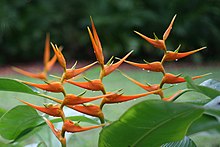 | |
Heliconia latispatha inflorescences | |
Scientific classification  | |
| Kingdom: | Plantae |
Clade: | Angiosperms |
Clade: | Monocots |
Clade: | Commelinids |
| Order: | Zingiberales |
| Family: | Heliconiaceae Vines[1] |
| Genus: | Heliconia L. |
Synonyms[2] | |
| |
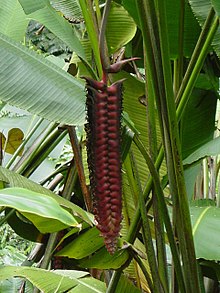
Heliconia mariae inflorescence

Heliconia psittacorum
Heliconia, derived from the Greek word Ἑλικώνιος (helikṓnios), is a genus of flowering plants in the family Heliconiaceae. Most of the ca 194 known species[3] are native to the tropical Americas, but a few are indigenous to certain islands of the western Pacific and Maluku.[2] Many species of Heliconia are found in the tropical forests of these regions. Several species are widely cultivated as ornamentals, and a few are naturalized in Florida, Gambia and Thailand.[4] Common names for the genus include lobster-claws, toucan peak, wild plantains or false bird-of-paradise. The last term refers to their close similarity to the bird-of-paradise flowers (Strelitzia). Collectively, these plants are also simply referred to as heliconias.
Contents
1 Description
1.1 Leaf
1.2 Flower
1.3 Seeds
2 Taxonomy
3 Species
4 Distribution and habitat
5 Ecology
5.1 Bats
5.1.1 Pollination
5.1.2 Habitat
5.2 Insects
5.3 Hummingbirds
6 Cultivation
7 Uses
8 Gallery
9 See also
10 References
11 Bibliography
12 External links
Description
These herbaceous plants range from 0.5 to nearly 4.5 meters (1.5–15 feet) tall depending on the species.[5] The simple leaves of these plants are 15–300 cm (6 in–10 ft). They are characteristically long, oblong, alternate, or growing opposite one another on non-woody petioles often longer than the leaf, often forming large clumps with age. Their flowers are produced on long, erect or drooping panicles, and consist of brightly colored waxy bracts, with small true flowers peeping out from the bracts. The growth habit of heliconias is similar to Canna, Strelitzia, and bananas, to which they are related.The flowers can be hues of reds, oranges, yellows, and greens, and are subtended by brightly colored bracts. Floral shape often limits pollination to a subset of the hummingbirds in the region.[6]
Leaf
The leaves in different positions on the plant have a different absorption potential of sunlight for photosynthesis when exposed to different degrees of sunlight.[7]
Flower
The flowers produce ample nectar that attracts pollinators, most prevalent of which are hummingbirds.[8]

Heliconia rostrata growing in West Bengal, India

Heliconia rostrata Inflorescence close up
Seeds
Fruits are blue-purple when ripe and primarily bird dispersed.[9] Studies of post-dispersal seed survival showed that seed size was not a determinant. The highest amount of seed predation came from mammals.[10]
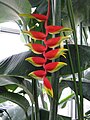
Heliconia rostrata inflorescence
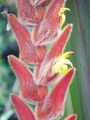
Closeup of Heliconia vellerigera inflorescence

H. psittacorum × H. spathocircinata cv. Golden Torch
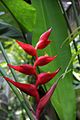
Heliconia bourgaeana Petersen
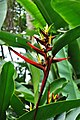
Heliconia longiflora

Taxonomy
The Heliconia are a monophyletic genus in the family Heliconiaceae, but was formerly included in the family Musaceae, which includes the bananas (e.g., Musa, Ensete;[11]). However, the APG system of 1998, and its successor, the APG II system of 2003, confirm the Heliconiaceae as distinct and places them in the order Zingiberales, in the commelinid clade of monocots.
Cladogram: Phylogeny of Zingiberales[12] | |||||||||||||||||||||||||||||||||||||||||||||||||||
.mw-parser-output table.cladeborder-spacing:0;margin:0;font-size:100%;line-height:100%;border-collapse:separate;width:auto.mw-parser-output table.clade table.cladewidth:100%.mw-parser-output table.clade tdborder:0;padding:0;vertical-align:middle;text-align:center.mw-parser-output table.clade td.clade-labelwidth:0.8em;border:0;padding:0 0.2em;vertical-align:bottom;text-align:center.mw-parser-output table.clade td.clade-slabelborder:0;padding:0 0.2em;vertical-align:top;text-align:center.mw-parser-output table.clade td.clade-barvertical-align:middle;text-align:left;padding:0 0.5em.mw-parser-output table.clade td.clade-leafborder:0;padding:0;text-align:left;vertical-align:middle.mw-parser-output table.clade td.clade-leafRborder:0;padding:0;text-align:right
|
Species
Species accepted by Kew Botanic Gardens[4]
Heliconia abaloi -Colombia
Heliconia acuminata - South America
Heliconia adflexa - S Mexico, Guatemala, Honduras
Heliconia aemygdiana - South America
Heliconia albicosta - Costa Rica
Heliconia angelica - Ecuador
Heliconia angusta - SE Brazil
Heliconia apparicioi - Ecuador, Peru, NW Brazil
Heliconia arrecta - Colombia
Heliconia atratensis - Colombia
Heliconia atropurpurea - Colombia, Panama, Costa Rica
Heliconia aurantiaca - S Mexico, Central America
Heliconia auriculata - Bahia
Heliconia badilloi - Colombia
Heliconia barryana - Chiriquí
Heliconia beckneri - Costa Rica
Heliconia bella - Panama
Heliconia berguidoi - E Panama
Heliconia berriziana - Colombia
Heliconia berryi - Napo
Heliconia bihai - West Indies, N South America
Heliconia bourgaeana - S Mexico, Central America
Heliconia brachyantha - Panama, Colombia, Venezuela
Heliconia brenneri - Ecuador
Heliconia burleana - Colombia, Ecuador, Peru
Heliconia caltheaphylla - Costa Rica
Heliconia caquetensis - Colombia
Heliconia carajaensis - Pará
Heliconia caribaea - West Indies
Heliconia carmelae - Colombia
Heliconia chartacea - N South America
Heliconia chrysocraspeda - Colombia
Heliconia clinophila - Costa Rica, Panama
Heliconia colgantea - Costa Rica, Panama
Heliconia collinsiana - S Mexico, Central America
Heliconia combinata - Colombia
Heliconia cordata - Colombia, Ecuador
Heliconia crassa - Guatemala
Heliconia cristata - Panama
Heliconia cucullata - Costa Rica, Panama
Heliconia curtispatha - Colombia, Ecuador, Central America
Heliconia danielsiana - Costa Rica, Panama
Heliconia darienensis - Colombia, Panama
Heliconia dasyantha - Suriname, French Guiana
Heliconia densiflora - Trinidad, N South America
Heliconia dielsiana - NW South America
Heliconia donstonea - Colombia, Ecuador
Heliconia episcopalis - South America
Heliconia estherae - Colombia
Heliconia estiletioides - Colombia
Heliconia excelsa - Napo
Heliconia farinosa - SE Brazil, NE Argentina
Heliconia faunorum - Panama
Heliconia fernandezii - Antioquia
Heliconia × flabellata - Ecuador
Heliconia foreroi - Colombia
Heliconia fragilis - Colombia
Heliconia fredberryana - Imbabura
Heliconia fugax - Peru
Heliconia gaiboriana - Los Ríos
Heliconia gigantea - Colombia
Heliconia gloriosa - Peru
Heliconia gracilis - Costa Rica
Heliconia griggsiana - Colombia, Ecuador
Heliconia harlingii - Ecuador
Heliconia hirsuta - Central + South America, Trinidad
Heliconia holmquistiana - Colombia
Heliconia huilensis - Colombia
Heliconia ignescens - Costa Rica, Panama
Heliconia imbricata - Costa Rica, Panama, Colombia
Heliconia impudica - Ecuador
Heliconia indica - Papuasia, Maluku
Heliconia intermedia - Colombia
Heliconia irrasa - Costa Rica, Panama, Nicaragua
Heliconia julianii - N South America
Heliconia juruana - Ecuador, Peru, NW Brazil
Heliconia kautzkiana - Espírito Santo
Heliconia lanata - Solomon Islands
Heliconia lankesteri - Costa Rica, Panama
Heliconia lasiorachis - Colombia, Peru, NW Brazil
Heliconia latispatha - from S Mexico to Peru
Heliconia laufao - Samoa
Heliconia laxa - Colombia
Heliconia lentiginosa - Antioquia
Heliconia librata - S Mexico, Central America
Heliconia lingulata - Peru, Bolivia
Heliconia litana - Imbabura
Heliconia longiflora - Colombia, Ecuador, Central America
Heliconia longissima - Colombia
Heliconia lophocarpa - Costa Rica, Panama
Heliconia lourteigiae - South America
Heliconia lozanoi - Colombia
Heliconia luciae - B Amazonas
Heliconia lutea - Panama
Heliconia luteoviridis - Colombia
Heliconia lutheri - Ecuador
Heliconia maculata - Panama
Heliconia magnifica - Panama
Heliconia × mantenensis - Minas Gerais
Heliconia marginata - N South America, S Central America
Heliconia mariae - NW South America, Central America
Heliconia markiana - Ecuador
Heliconia marthiasiae - S Mexico, Central America
Heliconia meridensis - Colombia, Venezuela
Heliconia metallica - N South America, Central America
Heliconia monteverdensis - Costa Rica
Heliconia mooreana - Guerrero
Heliconia mucilagina - Colombia
Heliconia mucronata - Venezuela, NW Brazil
Heliconia mutisiana - Colombia
Heliconia nariniensis - Colombia, Ecuador
Heliconia necrobracteata - Panama
Heliconia × nickeriensis - Suriname, French Guiana
Heliconia nigripraefixa - Colombia, Ecuador, Panama
Heliconia nitida - Colombia
Heliconia nubigena - Costa Rica, Panama
Heliconia nutans - Costa Rica, Panama
Heliconia obscura - Ecuador, Peru
Heliconia obscuroides - Colombia, Ecuador, Peru
Heliconia oleosa - Colombia
Heliconia ortotricha - Colombia, Ecuador, Peru
Heliconia osaensis - Colombia, Central America
Heliconia paka - Fiji
Heliconia paludigena - Ecuador
Heliconia papuana - New Guinea
Heliconia pardoi - Ecuador
Heliconia pastazae - Ecuador
Heliconia peckenpaughii - Napo
Heliconia pendula - Guiana, Fr Guiana, NE Brazil
Heliconia penduloides - Peru
Heliconia peteriana - Ecuador
Heliconia × plagiotropa - Ecuador
Heliconia platystachys - NW South America, S Central America
Heliconia pogonantha - NW South America, S Central America
Heliconia pruinosa - Peru
Heliconia pseudoaemygdiana - Rio de Janeiro
Heliconia psittacorum - N South America, Panama, Trinidad
Heliconia ramonensis - Costa Rica, Panama
Heliconia × rauliniana - Venezuela
Heliconia regalis - Colombia, Ecuador
Heliconia reptans - Colombia
Heliconia reticulata - NW South America, S Central America
Heliconia revoluta - Colombia, Venezuela, NW Brazil
Heliconia rhodantha - Colombia
Heliconia richardiana - NE South America
Heliconia rigida - Colombia
Heliconia riopalenquensis - Ecuador
Heliconia rivularis - São Paulo
Heliconia robertoi - Colombia
Heliconia robusta - Peru, Bolivia
Heliconia rodriguensis - Venezuela
Heliconia rodriguezii - Costa Rica
Heliconia rostrata - Colombia, Ecuador, Peru, Bolivia
Heliconia samperiana - Colombia
Heliconia sanctae-martae - Sierra Nevada de Santa Marta
Heliconia sanctae-theresae - Antioquia
Heliconia santaremensis - Pará
Heliconia sarapiquensis - Costa Rica, Panama
Heliconia scarlatina - Colombia, Panama, Peru
Heliconia schiedeana - Mexico
Heliconia schumanniana - Colombia, Ecuador, Peru, N Brazil
Heliconia sclerotricha - Ecuador
Heliconia secunda - Costa Rica, Nicaragua
Heliconia sessilis - Panama
Heliconia signa-hispanica - Colombia
Heliconia solomonensis - Solomon Islands, Bismarck Archipelago
Heliconia spathocircinata - South America, Panama, Trinidad
Heliconia spiralis - Colombia
Heliconia spissa - S Mexico, Central America
Heliconia standleyi - Ecuador, Peru
Heliconia stella-maris - Colombia
Heliconia stilesii - Costa Rica, Panama
Heliconia stricta - N South America
Heliconia subulata - South America
Heliconia tacarcunae - Panama
Heliconia talamancana - Costa Rica, Panama
Heliconia tandayapensis - Ecuador
Heliconia tenebrosa - Colombia, NE Peru, NW Brazil
Heliconia terciopela - Colombia
Heliconia thomasiana - Panama
Heliconia timothei - NE Peru, NW Brazil
Heliconia titanum - Colombia
Heliconia tortuosa - S Mexico, Central America
Heliconia trichocarpa - Costa Rica, Panama, Colombia
Heliconia tridentata - Colombia
Heliconia triflora - B Amazonas
Heliconia umbrophila - Costa Rica
Heliconia uxpanapensis - Veracruz
Heliconia vaginalis - Costa Rica, Panama, Colombia, Ecuador
Heliconia vellerigera - Ecuador, Peru
Heliconia velutina - Colombia, Ecuador, Peru, NW Brazil
Heliconia venusta - Colombia, Ecuador
Heliconia villosa - Venezuela
Heliconia virginalis - Ecuador
Heliconia wagneriana - Central America, N South America, Trinidad
Heliconia willisiana - Pichincha
Heliconia wilsonii - Costa Rica, Panama
Heliconia xanthovillosa - Panama
Heliconia zebrina - Peru
Distribution and habitat
Most of the 194 known species[3] are native to the tropical Americas, but a few are indigenous to certain islands of the western Pacific and Maluku.[2] Many species of Heliconia are found in the tropical forests of these regions. Several species are widely cultivated as ornamentals, and a few are naturalized in Florida, Gambia and Thailand.[4]
Ecology
Heliconias are an important food source for forest hummingbirds, especially the hermits (Phathornithinae), some of which – such as the rufous-breasted hermit (Glaucis hirsuta) – also use the plant for nesting. The Honduran white bat (Ectophylla alba) also lives in tents it makes from heliconia leaves.
Bats
Pollination
Although Heliconia are almost exclusively pollinated by hummingbirds, some bat pollination has been found to occur. Heliconia solomonensis is pollinated by the macroglosine bat (Melonycteris woodfordi) in the Solomon Islands. Heliconia solomonensis has green inflorescences and flowers that open at night, which is typical of bat pollinated plants. The macroglosine bat is the only known nocturnal pollinator of Heliconia solomonensis.[13]
Habitat
Many bats use Heliconia leaves for shelter. The Honduran white bat, Ectohylla alba, utilizes five species of Heliconia to make diurnal tent shaped roosts. The bat cuts the side veins of the leaf extending from the midrib causing the leaf to fold like a tent. This structure provides the bat with shelter from rain, sun, and predators. In addition, the stems of the Heliconia leaves are not strong enough to carry the weight of typical bat predators, so shaking of the leaf alerts roosting bats to presence of predators.[14] The bats Artibeus anderseni and A. phaeotis form tents from the leaves of Heliconia in the same manner as the Honduran white bat.[15] The Neotropical disk-winged bat, Thyroptera tricolor, has suction disks on the wrists which allow it to cling to the smooth surfaces of the Heliconia leaves. This bat roosts head up in the rolled young leaves of Heliconia plants.[16]
Insects
Heliconias provide shelter for a diverse range of insects within their young rolled leaves and water-filled floral bracts. Insects that inhabit the rolled leaves often feed upon the inner surfaces of the leaf, such as beetles of the family Chrysomelidae. In bracts containing small amounts of water, fly larvae and beetles are the dominant inhabitants. In bracts with greater quantities of water the typical inhabitants are mosquito larva. Insects living in the bracts often feed on the bract tissue, nectar of the flower, flower parts, other insects, microorganisms, or detritus in the water contained in the bract (Siefert 1982). Almost all species of Hispini beetles that use rolled leaves are obligate herbivores of plants of the order of Zingiberales, which includes Heliconia. These beetles live in and feed from the rolled leaf, the stems, the inflorescences, or the unfurled mature leaves of the Heliconia plant. In addition, these beetles deposit their eggs on the leaf surface, petioles of immature leaves, or in the bracts of the Heliconia.[17] Furthermore, some wasp species such as Polistes erythrocephalus build their nest on the protected underside of large leaves.[18]
Hummingbirds
Hummingbirds are the main pollinators of flowers in the genus Heliconia (order Zingiberales: family Heliconiaceae) in many locations. The concurrent diversification of hummingbird pollinated taxa in the order Zingiberales and the hummingbird family (Trochilidae: Phaethorninae) 18 mya supports that these radiations have significantly influenced one another through evolutionary time.[19] Kress and Specht 2005). At La Selva research station in Costa Rica it was found that specific species of Heliconia have specific hummingbird pollinators.[20] These hummingbirds can be organized into two different groups: hermits and non-hermits. Hermits are a subfamily of Phaethornithinae, consisting of the genera Anopetia, Eutoxeres, Glaucis, Phaethornis, Ramphodon, and Threnetes.[21] Non-hermits are a paraphyletic group within the Trochilidae, comprising several clades (McGuire 2008). Hermits are generally traplining foragers, where individuals visit a repeated circuit of high-reward flowers instead of holding fixed territories[20][22] Non-hermits are territorial over their Heliconia clumps, causing greater self-pollination.[20] Hermits tend to have long curved bills while non-hermits tend to possess short straight bills, a morphological difference that likely spurred the divergence of these groups in the Miocene era.[23][24] Characteristics of Heliconia flowers that select for either hermit or non-hermit pollinator specificity are degree of self-compatibility, flowering phenology, nectar production, color, and shape of flower.[25][26][23] The hummingbird itself will choose the plants its feeds from based on its beak shape, its perch on the plant, and its territory choice.[27]
It was found that hummingbird visits to the Heliconia flower did not affect its production of nectar.[28] This may account for the flowers not having a consistent amount of nectar produced from flower to flower.
Different Heliconia species have different flowering seasons. This suggests that the species compete for pollinators. It was found that many species of Heliconia, even the newly colonized species, all had many pollinators visit.[29]
Cultivation
Several cultivars and hybrids have been selected for garden planting, including:
H. psittacorum × H. spathocircinata, both species of South America, mainly Brazil
H. × rauliniana = H. marginata (Venezuela) × H. bihai (Brazil)
H. chartacea cv. 'Sexy Pink'
Most commonly grown landscape Heliconia species include Heliconia augusta, H. bihai, H. brasiliensis, H. caribaea, H. latispatha, H. pendula, H. psittacorum, H. rostrata, H. schiediana, and H. wagneriana.
Uses
Heliconias are grown for the florist's trade and as landscape plants. These plants do not grow well in cold, dry conditions. They are very drought intolerant, but can endure some soil flooding. Heliconias need an abundance of water, sunlight, and soils that are rich in humus in order to grow well. These flowers are grown in tropical regions all over the world as ornamental plants.[30] The flower of H. psittacorum (Parrot Heliconia) is especially distinctive, its greenish-yellow flowers with black spots and red bracts reminding of the bright plumage of parrots.

Heliconia in Lagos, Nigeria
Gallery
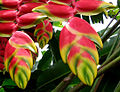
Heliconia rostrata, in a botanical garden, Costa Rica
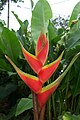
Heliconia wagneriana in Florida

Heliconia sp. in tropical rain forest at Sierra del Escambray, Cuba
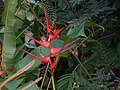
Heliconia sp. in tropical rain forest at Sierra del Escambray, Cuba

Heliconia stricta (Dwarf Jamaican leaf). Location: Maui, Kula Ace Hardware and Nursery


See also
National Tropical Botanical Garden, designated a conservation center by the Heliconia Society International
References
^ Angiosperm Phylogeny Group (2009). "An update of the Angiosperm Phylogeny Group classification for the orders and families of flowering plants: APG III" (PDF). Botanical Journal of the Linnean Society. 161 (2): 105–121. doi:10.1111/j.1095-8339.2009.00996.x. Retrieved 2013-06-26..mw-parser-output cite.citationfont-style:inherit.mw-parser-output qquotes:"""""""'""'".mw-parser-output code.cs1-codecolor:inherit;background:inherit;border:inherit;padding:inherit.mw-parser-output .cs1-lock-free abackground:url("//upload.wikimedia.org/wikipedia/commons/thumb/6/65/Lock-green.svg/9px-Lock-green.svg.png")no-repeat;background-position:right .1em center.mw-parser-output .cs1-lock-limited a,.mw-parser-output .cs1-lock-registration abackground:url("//upload.wikimedia.org/wikipedia/commons/thumb/d/d6/Lock-gray-alt-2.svg/9px-Lock-gray-alt-2.svg.png")no-repeat;background-position:right .1em center.mw-parser-output .cs1-lock-subscription abackground:url("//upload.wikimedia.org/wikipedia/commons/thumb/a/aa/Lock-red-alt-2.svg/9px-Lock-red-alt-2.svg.png")no-repeat;background-position:right .1em center.mw-parser-output .cs1-subscription,.mw-parser-output .cs1-registrationcolor:#555.mw-parser-output .cs1-subscription span,.mw-parser-output .cs1-registration spanborder-bottom:1px dotted;cursor:help.mw-parser-output .cs1-hidden-errordisplay:none;font-size:100%.mw-parser-output .cs1-visible-errorfont-size:100%.mw-parser-output .cs1-subscription,.mw-parser-output .cs1-registration,.mw-parser-output .cs1-formatfont-size:95%.mw-parser-output .cs1-kern-left,.mw-parser-output .cs1-kern-wl-leftpadding-left:0.2em.mw-parser-output .cs1-kern-right,.mw-parser-output .cs1-kern-wl-rightpadding-right:0.2em
^ abc Kew World Checklist of Selected Plant Families
^ ab Christenhusz, M. J. M.; Byng, J. W. (2016). "The number of known plants species in the world and its annual increase". Phytotaxa. Magnolia Press. 261 (3): 201–217. doi:10.11646/phytotaxa.261.3.1.
^ abc Kew World Checklist of Selected Plant Families, genus Heliconia
^ Berry, Fred; Kress, John (1991). Heliconia Identification Guide. Smithsonian Institution Press.
^ Gilman, Edward; Meerow, Alan (1 May 2007). "Heliconia spp. Heliconia". University of Florida IFAS Extension.
^ He, J.; Chee, C.; Goh, C. "'Photoinhibition' of Heliconia under natural tropical conditions: the importance of leaf orientation for light interception and leaf temperature". Plant, Cell & Environment. 19: 1238–1248. doi:10.1111/j.1365-3040.1996.tb00002.x.
^ Bruna, E. M.; Kress, W. J.; Marques, F.; da Silva, O. F. (2004). "Heliconia acuminata reproductive success is independent of local floral density". Acta Amazonica. 34 (3): 467–471. doi:10.1590/s0044-59672004000300012.
^ Uriarte, M. Anciães; da Silva, M. T.B.; Rubim, P.; Johnson, E.; Bruna, E. M. (2011). "Disentangling the drivers of reduced long-distance seed dispersal by birds in an experimentally fragmented landscape". Ecology. 92 (4): 924–937. doi:10.1890/10-0709.1.
^ Hoii, Karen; Lulow, Megan (2006). "Effects of species, habitat, and distance from edge on post-dispersal seed predation in a Tropical Rainforest". Biotropica. 29: 459–468. doi:10.1111/j.1744-7429.1997.tb00040.x.
^ Walter Judd; et al. (2007). Plant Systematics: A phylogenetic approach (3rd ed.). Sunderland: Sinauer Associates, Inc.CS1 maint: Explicit use of et al. (link)
^ Sass et al 2016.
^ Kress, W. J. (1985). "Bat Pollination of an Old World Heliconia". Biotropica. 17 (4): 302–308. doi:10.2307/2388592.
^ Timm, R.W.; Mortimer, J. (1976). "Selection of Roost sited by Honduran White Bats, Ectophylla Alba (Chiroptera: Phyllostomatidae)". Ecology. 57 (2): 385–389. doi:10.2307/1934829.
^ Timm, R.W.; Patterson, B.D. (1987). "Tent Construction by bats of the genera Artibeus and Uroderma". Fieldiana: Zoology. 29: 188–212.
^ Findley, J.S.; Wilson, D.E. (1974). "Observations on the Neotropical disk-winged bat, Thyroptera tricolor spix". Journal of Mammalogy. 55 (3): 563–571. doi:10.2307/1379546. PMID 4853410.
^ Strong Jr., Donald R. (1977). "Insect Species Richness: Hispine Beetles of the Heliconia Latispatha". Ecology. 58. doi:10.2307/1939006.
^ "Nesting habits and nest symbionts of Polistes erythrocephalus Latreille (Hymenoptera Vespidae) in Costa Rica" (PDF). Retrieved 14 October 2014.
^ Bleiweiss, R. (1998). "Tempo and mode of hummingbird evolution". Biological Journal of the Linnean Society. 65 (1): 63–76. doi:10.1111/j.1095-8312.1998.tb00351.x.
^ abc Stiles, Gary (1975). "Ecology, flowering phenology, and hummingbird pollination of some Costa Rican "Heliconia" species". Ecology. 56: 285–301. doi:10.2307/1934961.
^ McGuire, J. A.; Witt, C. C.; Remsen Jr., J. V.; Dudley, R.; Altshuler, D.L. (2008). "A higher-level taxonomy for hummingbirds". Journal of Ornithology. 150: 155–165. doi:10.1007/s10336-008-0330-x.
^ Dobkin, D. S. (1984). "Flowering patterns of long-lived "Heliconia" inflorescences: implications for visiting and resident nectarivores". Oecologia. 64 (2): 245–254. doi:10.1007/bf00376878.
^ ab Graham, C. H.; Parra, J. L.; Rahbek, C.; McGuire, J. A. (2009). "Phylogenetic structure in tropical hummingbird communities". Proceedings of the National Academy of Sciences of the United States of America. 106: 19673–19678. doi:10.1073/pnas.0901649106. PMC 2780942.
^ Temeles, E. J.; Miller, J. S.; Rifkin, J. L. (2010). "Evolution of sexual dimorphism in bill size and shape of hermit hummingbirds (Phaethornithinae): a role for ecological causation". Philosophical Transactions of the Royal Society. 365: 1053–1063. doi:10.1098/rstb.2009.0284. PMC 2830232. PMID 20194168.
^ Kress, W. J.; Specht, C. D. (2005). "Between Cancer and Capricorn: phylogeny, evolution and ecology of the primarily tropical Zingiberales". Biologiske Skrifter. 55: 459–478.
^ Meléndez-Ackerman, E. J.; Speranza, P.; Kress, W. J.; Rohena, L.; Toledo, E.; Cortés, C.; Treece, D.; Gitzendanner, M.; Soltis, P.; Soltis, D. (2005). "Microevolutionary processes inferred from AFLP and morphological variation in Heliconia bihai (Heliconiaceae)". International Journal of Plant Sciences. 166 (5): 781–794. doi:10.1086/431231.
^ Linhart, Yan (1973). "Ecological and behavioral determinants of pollen dispersal in hummingbird- pollinated Heliconia". The American Naturalist. 107: 511–523. doi:10.1086/282854.
^ Feinsinger, Peter (1983). "Variable nectar secretion in a Heliconia species pollinated by hermit hummingbirds". Biotropica. 15: 48–52. doi:10.2307/2387998.
^ Feinsinger, Peter (1978). "Ecological interactions between plants and hummingbirds in a successional tropical community". Ecological Monographs. 48: 269–287. doi:10.2307/2937231.
^ Ong, Chong Ren (March 2007). "Heliconia Basics". Green Culture Singapore.
Bibliography
.mw-parser-output .refbeginfont-size:90%;margin-bottom:0.5em.mw-parser-output .refbegin-hanging-indents>ullist-style-type:none;margin-left:0.mw-parser-output .refbegin-hanging-indents>ul>li,.mw-parser-output .refbegin-hanging-indents>dl>ddmargin-left:0;padding-left:3.2em;text-indent:-3.2em;list-style:none.mw-parser-output .refbegin-100font-size:100%
Iles, William J.D.; Sass, Chodon; Lagomarsino, Laura; Benson-Martin, Gracie; Driscoll, Heather; Specht, Chelsea D. (December 2016). "The phylogeny of Heliconia (Heliconiaceae) and the evolution of floral presentation". Molecular Phylogenetics and Evolution. doi:10.1016/j.ympev.2016.12.001.
Sass, C; Iles, WJ; Barrett, CF; Smith, SY; Specht, CD (21 January 2016). "Revisiting the Zingiberales: using multiplexed exon capture to resolve ancient and recent phylogenetic splits in a charismatic plant lineage". PeerJ. 4: e1584. doi:10.7717/peerj.1584. PMC 4727956. PMID 26819846.
External links
 | Wikimedia Commons has media related to Heliconia. |
Monocot families (USDA)- links at CSDL
 Families of Zingiberales Families of Zingiberales | |
|---|---|
| Banana-families |
|
Zingiberineae (Ginger-families) |
|


