Banovina of Croatia
Banovina of Croatia Banovina Hrvatska | |||||||||||||||||||||
|---|---|---|---|---|---|---|---|---|---|---|---|---|---|---|---|---|---|---|---|---|---|
| 1939–1943 | |||||||||||||||||||||
 Flag  Coat of arms | |||||||||||||||||||||
 Banovina of Croatia (red) within Yugoslavia (light yellow) | |||||||||||||||||||||
| Status | Banate of Yugoslavia | ||||||||||||||||||||
| Capital | Zagreb | ||||||||||||||||||||
| Largest city | Zagreb[1] | ||||||||||||||||||||
| Official languages | Serbo-Croato-Slovene | ||||||||||||||||||||
| Government | Banate | ||||||||||||||||||||
| Ban | |||||||||||||||||||||
• 1939–1941 | Ivan Šubašić | ||||||||||||||||||||
| Legislature | Parliament | ||||||||||||||||||||
| Historical era | Interwar period World War II | ||||||||||||||||||||
• Cvetković–Maček Agreement | 24 August 1939 | ||||||||||||||||||||
• Axis invasion of Yugoslavia | 6 April 1941 | ||||||||||||||||||||
• World War II in Yugoslavia | 1941–1945 | ||||||||||||||||||||
• Federal State of Croatia established | 13 June 1943 | ||||||||||||||||||||
| Area | |||||||||||||||||||||
| 1939 | 65,456 km2 (25,273 sq mi) | ||||||||||||||||||||
| Population | |||||||||||||||||||||
• 1939 | 4,024,601 | ||||||||||||||||||||
| Currency | Yugoslav dinar | ||||||||||||||||||||
| ISO 3166 code | HR | ||||||||||||||||||||
| |||||||||||||||||||||
| Today part of |  Croatia Croatia Bosnia and Herzegovina Bosnia and Herzegovina Serbia Serbia Slovenia Slovenia | ||||||||||||||||||||


The Banovina of Croatia or Banate of Croatia (Serbo-Croatian: Banovina Hrvatska / Бановина Хрватска) was an autonomous province (banovina) of the Kingdom of Yugoslavia between 1939 and 1941. It was formed by combining the Sava Banovina and Littoral Banovina, but also with small parts of the Drina, Zeta, and Danube banovinas. Its capital was Zagreb and it included most of present-day Croatia along with portions of Bosnia and Herzegovina and Serbia. It included area of 65,456 km2 and had population of 4,024,601. The Ban of the Banovina of Croatia during this period was Ivan Šubašić.
Contents
1 Background
2 History
3 Population
4 Sports
5 Gallery
6 See also
7 Notes
8 References
9 External links
Background
The banovinas of Yugoslavia, established in 1929, deliberately avoided following ethnic or religious boundaries which resulted in the country's ethnic Croats, like other ethnic groups, being divided among several banovinas. Following a political struggle within the unitary Kingdom of Yugoslavia, Croat leaders won autonomy for a new ethnic-based banovina with the Cvetković-Maček Agreement.
History
On the basis of the Cvetković–Maček Agreement, and the Decree on the Banate of Croatia (Uredba o Banovini Hrvatskoj) dated 24 August 1939, the Banate of Croatia was created.[2] The entire area of the Sava and Littoral Banovinas was combined and parts of the Vrbas, Zeta, Drina and Danube banovinas (districts Brčko, Derventa, Dubrovnik, Fojnica, Gradačac, Ilok, Šid and Travnik) were added to form the Banate of Croatia.[3] The borders of the Banate of Croatia are partly the historical borders of Croatia, and partly based on the application of the principle of ethnicity according to which Bosnian and Herzegovinian territory with a majority Croat population was annexed to the Banate.[2]
Under the Agreement, central government continued to control defense, internal security, foreign policy, trade, and transport; but an elected Sabor and a crown-appointed ban would decide internal matters in Croatia. Ironically, the Agreement fueled separatism. Maček and other Croats viewed autonomy as a first step toward full Croatian independence, so they began haggling over territory; Serbs attacked Cvetković, charging that the Agreement brought them no return to democracy and no autonomy; Muslims demanded an autonomous Bosnia; and Slovenes and Montenegrins espoused federalism. Prince Regent Paul appointed a new government with Cvetković as prime minister and Maček as vice prime minister, but it gained little support.[4] On May 1940, fairly free local elections were held in rural municipalities, showing some weakening of support for Maček and Croatian Peasant Party due to poor economic showing.
In 1941, the World War II Axis Powers occupied Yugoslavia, and establishing a government-in-exile in London. Legally, the Banovina of Croatia remained a part of the occupied Kingdom of Yugoslavia, while the Axis proceeded to dismember Yugoslav territory and the Banovina along with it. Some of the coastal areas from Split to Zadar and near the Gulf of Kotor were annexed by Fascist Italy but the remainder was added to the Independent State of Croatia. As the Kingdom of Yugoslavia became the Democratic Federal Yugoslavia with the success of the Yugoslav Partisans, a new Federal State of Croatia was established within it, succeeding the Banovina.
Population
In 1939, the banovina of Croatia had a population of 4,299,430 of which three quarters was Roman Catholic, one-fifth was Orthodox, and 4 percent was Muslim.[5] The banovina was divided into 116 districts (kotari) of which 95 had an absolute and 5 had a relative Catholic majority.[5]
Sports
The Croatian Football Federation was the governing body of football within the Banovina. It organized a domestic league and a national team. The Banovina of Croatia had four international matches: two pairs of home-and-away matches against Switzerland and Hungary. The Croatian Rowing Championships were held on 29 June 1940.[6]
Croatia men's national ice hockey team played its first friendly game against Slovakia on February 9, 1941 in Bratislava and lost 6-1.[7]
The Croatian Boxing Federation was reconstituted on 5 October 1939 as the governing body of boxing within the entire Banovina of Croatia.[8]
Gallery
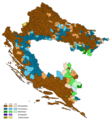
Religious map of the Banovina Croatia by municipality, according to the 1931 census.

Territory of the Banovina Croatia compared to territory of the present-day countries as well as the prior existing banates.
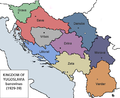
Banates of the Kingdom of Yugoslavia prior to the establishment of the Banovina of Croatia.
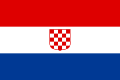
State flag and ensign of the Banovina of Croatia


Lesser coat of arms of the Banovina of Croatia

Police ensign with motto "u službi" in Croatian meaning on duty in English.

Ethnic map of Yugoslavia, 1940.


See also
Part of a series on the |
|---|
| History of Croatia |
 |
Early history
|
Middle Ages
|
Modernity
|
20th century
|
Contemporary Croatia
|
Timeline |
 Croatia portal Croatia portal |
- Kingdom of Yugoslavia
- Socialist Republic of Croatia
- Timeline of Croatian history
- Ban of Croatia
Notes
^ Karta Banovine Hrvatske "U korist pokreta za pismenost", naklada Klub ABC i Seljačka sloga
^ ab Croatian History Museum[permanent dead link]
^ Uredba o banovini Hrvatskoj (in Croatian)
^ The Sporazum, Tripartitate Pact, and Outbreak of World War II
^ ab Velikonja (2003), p. 146
^ Kronologija hrvatskog veslanja Archived August 13, 2009, at the Wayback Machine
^ PREHĽAD ZÁPASOV A-tímu SR od roku 1940 Archived 2013-05-31 at the Wayback Machine
^ Povijest hrvatskog sporta: Boks[permanent dead link]
References
Velikonja, Mitja (2003). Religious Separation and Political Intolerance in Bosnia-Herzegovina. College Station: Texas A&M University Press. ISBN 9781585442263..mw-parser-output cite.citationfont-style:inherit.mw-parser-output .citation qquotes:"""""""'""'".mw-parser-output .citation .cs1-lock-free abackground:url("//upload.wikimedia.org/wikipedia/commons/thumb/6/65/Lock-green.svg/9px-Lock-green.svg.png")no-repeat;background-position:right .1em center.mw-parser-output .citation .cs1-lock-limited a,.mw-parser-output .citation .cs1-lock-registration abackground:url("//upload.wikimedia.org/wikipedia/commons/thumb/d/d6/Lock-gray-alt-2.svg/9px-Lock-gray-alt-2.svg.png")no-repeat;background-position:right .1em center.mw-parser-output .citation .cs1-lock-subscription abackground:url("//upload.wikimedia.org/wikipedia/commons/thumb/a/aa/Lock-red-alt-2.svg/9px-Lock-red-alt-2.svg.png")no-repeat;background-position:right .1em center.mw-parser-output .cs1-subscription,.mw-parser-output .cs1-registrationcolor:#555.mw-parser-output .cs1-subscription span,.mw-parser-output .cs1-registration spanborder-bottom:1px dotted;cursor:help.mw-parser-output .cs1-ws-icon abackground:url("//upload.wikimedia.org/wikipedia/commons/thumb/4/4c/Wikisource-logo.svg/12px-Wikisource-logo.svg.png")no-repeat;background-position:right .1em center.mw-parser-output code.cs1-codecolor:inherit;background:inherit;border:inherit;padding:inherit.mw-parser-output .cs1-hidden-errordisplay:none;font-size:100%.mw-parser-output .cs1-visible-errorfont-size:100%.mw-parser-output .cs1-maintdisplay:none;color:#33aa33;margin-left:0.3em.mw-parser-output .cs1-subscription,.mw-parser-output .cs1-registration,.mw-parser-output .cs1-formatfont-size:95%.mw-parser-output .cs1-kern-left,.mw-parser-output .cs1-kern-wl-leftpadding-left:0.2em.mw-parser-output .cs1-kern-right,.mw-parser-output .cs1-kern-wl-rightpadding-right:0.2em
External links
 | Wikimedia Commons has media related to Banovina of Croatia. |
Map of Yugoslav banovinas with the Banovina of Croatia (in Hungarian)
Banovinas of the Kingdom of Yugoslavia | ||||||||||
|---|---|---|---|---|---|---|---|---|---|---|
| 1929–1941 |
|  | ||||||||
| Proposed |
| |||||||||


