Mode-class destroyer
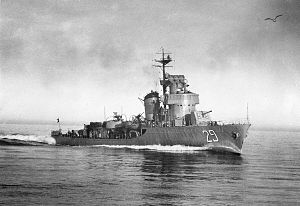 Mode at sea | |
| Class overview | |
|---|---|
| Name: | Mode class |
| Operators: |  Swedish Navy Swedish Navy |
| Preceded by: | Romulus class |
| Succeeded by: | Visby class |
| Built: | 1941–1943 |
In commission: | 1942–1970 |
| Planned: | 4 |
| Completed: | 4 |
| Scrapped: | 4 |
| General characteristics | |
| Type: | Destroyer/Frigate |
| Displacement: |
|
| Length: | 255 ft 11 in (78.00 m) |
| Beam: | 26 ft 3 in (8.00 m) |
| Draught: | 8 ft 10 in (2.69 m) |
| Propulsion: | 2 oil fired boilers, 2 de Laval steam turbines, 16,000 shp (12 MW), 2 screws |
| Speed: | 30 knots (35 mph; 56 km/h) |
| Range: | 1,260 nmi (2,330 km) at 20 kn (23 mph; 37 km/h) |
| Complement: | 100 |
| Armament: |
|
The Mode class or Mjölner class was a class of coastal destroyers commissioned by the Royal Swedish Navy during World War II. The design was based on the preceding Psilander class purchased from Italy but with Swedish equipment and armament. The class was moderately upgraded and reclassified as frigates during the early part of the Cold War.
Contents
1 Background
2 Design and development
2.1 Armament
2.2 Name
3 Ships
4 Service
4.1 Modernisation
5 References
5.1 Notes
5.2 Bibliography
Background
At the start of World War II, Swedish destroyer design had culminated in the Göteborg class, a powerful but expensive design. To meet the needs of the rapidly expanding navy, Sweden looked to foreign designs, especially Italy, which provided four ships, two each of the Psilander and Romulus classes.[1] Italy also provided the blueprints for a more modern version of Psilander, which was used by the designers at Götaverken in Gothenburg as the basis to develop a new light destroyer. Götaverken also built the first two vessels of the class.[2]
Design and development
The destroyers have been described as, "more an expression of standardization, simplicity and simple building methods than carefully planned men of war."[3] They were small, only 78 m (256 ft) long, shorter than the British Hunt class of escort destroyers then being produced in large numbers for the Royal Navy and its allies. Displacement was 750 long tons (760 t) normal and 960 long tons (980 t) full load, beam 26 ft 3 in (8.00 m) and draught 8 ft 10 in (2.69 m).[4] The bridge was wider than the superstructure, giving the vessels a distinctive appearance from the prow compared to other Swedish destroyers.[1] The machinery consisted of two Penhoët A oil-fired boilers, which supplied steam to two de Laval geared steam turbines, each driving its own propeller. The turbines were rated at 16,000 shp (12,000 kW) to give a design speed of 30 knots (35 mph; 56 km/h). 190 long tons (190 t) of fuel was carried to give a range of 1,260 nautical miles (2,330 km) at 20 knots (23 mph; 37 km/h).[5]
Armament

The forward gun aboard Mjölner
The main armament consisted of three 10.5 cm (4 in) K/50 M42 guns produced by Bofors.[6] These were placed in separate mounts, one on the fore deck, one on the aft deck and one on the aft superstructure.[2] Air defence consisted of two 40 mm (1.57 in) K/60 M36 and two 20 mm (0.79 in) K/66 M40 anti-aircraft machine guns, also provided by Bofors.[6]
Three torpedo tubes for 53 cm (21 in) torpedoes were triple mounted aft of the superstructure and two depth charge throwers were mounted further towards the stern. 42 mines could also be carried for minelaying.[7]
Name
The class is known both as the Mode class, after the first vessel ordered, and the Mjölner class, after the first vessel launched.[4][2] The vessels were named after characters and objects in Norse mythology, Mode and Magne, the sons of Thor, his hammer Mjölnir and Munin, one of the ravens that serve Odin.[8]
Ships
| Name | Pennant numbers | Builder | Laid down | Launched | Commissioned | Stricken | Fate |
|---|---|---|---|---|---|---|---|
Mode | 29, 73 | Götaverken | September 1941 | 11 April 1942 | 12 November 1942 | 1 July 1970 | Sold for scrap in 1973 in Ystad |
Magne | 30, 74 | Götaverken | September 1941 | 25 April 1942 | November 1942 | January 1966 | Sold for scrap in 1973 in Ystad |
Munin | 31, 75 | Öresundsvarvet | September 1941 | 25 May 1942 | 3 January 1943 | 6 December 1968 | Sold for scrap in 1969 in Gothenburg |
Mjölner | 32, 76 | Eriksberg | September 1941 | 9 April 1942 | 12 November 1942 | 1 April 1966 | Sold for scrap in 1969 in Gothenburg |
Service

Mode in 1959 after conversion
The four destroyers of the class were launched in 1942 and entered service in the Royal Swedish Navy.[9] They operated in the escort role.[3] During World War II, they served as part of the Swedish coastal fleet enforcing the country's neutrality but suffered no loss.[10] Following the war, they escorted major warships like the anti-aircraft cruiser Gotland on goodwill visits to countries like Belgium, Ireland and France.[11]
Modernisation
The class were modernised between 1954 and 1955 and re-rated as frigates.[3] One of the 105 mm (4.1 in) main guns was removed, along with the triple 533 mm (21.0 in) torpedo tube mount. A single Squid depth charge launcher was fitted to improve anti-submarine capabilities and the 40 mm (1.6 in) guns were upgraded.[5] The class remained in service in this capacity until decommissioning.[4]
References
Notes
^ ab Kaudern 1989, p. 66.
^ abc Whitley 2002, p. 251.
^ abc Palmsteirna 1972, p. 64.
^ abc Gardiner & Chesneau 1980, p. 372.
^ ab Prendegast & Parkes 1961, p. 216.
^ ab Gogin 2015.
^ Kaudern 1989, p. 79.
^ Arbeitskreis für Wehrforschung 1977, p. 660.
^ Pettibone 2005, p. 251.
^ Lagvall 1991.
^ "Långresor och utlandsbesök med svenska örlogsfartyg mellan 1837 - 2005". flottansman.se. Archived from the original on 12 August 2010..mw-parser-output cite.citationfont-style:inherit.mw-parser-output qquotes:"""""""'""'".mw-parser-output code.cs1-codecolor:inherit;background:inherit;border:inherit;padding:inherit.mw-parser-output .cs1-lock-free abackground:url("//upload.wikimedia.org/wikipedia/commons/thumb/6/65/Lock-green.svg/9px-Lock-green.svg.png")no-repeat;background-position:right .1em center.mw-parser-output .cs1-lock-limited a,.mw-parser-output .cs1-lock-registration abackground:url("//upload.wikimedia.org/wikipedia/commons/thumb/d/d6/Lock-gray-alt-2.svg/9px-Lock-gray-alt-2.svg.png")no-repeat;background-position:right .1em center.mw-parser-output .cs1-lock-subscription abackground:url("//upload.wikimedia.org/wikipedia/commons/thumb/a/aa/Lock-red-alt-2.svg/9px-Lock-red-alt-2.svg.png")no-repeat;background-position:right .1em center.mw-parser-output .cs1-subscription,.mw-parser-output .cs1-registrationcolor:#555.mw-parser-output .cs1-subscription span,.mw-parser-output .cs1-registration spanborder-bottom:1px dotted;cursor:help.mw-parser-output .cs1-hidden-errordisplay:none;font-size:100%.mw-parser-output .cs1-visible-errorfont-size:100%.mw-parser-output .cs1-subscription,.mw-parser-output .cs1-registration,.mw-parser-output .cs1-formatfont-size:95%.mw-parser-output .cs1-kern-left,.mw-parser-output .cs1-kern-wl-leftpadding-left:0.2em.mw-parser-output .cs1-kern-right,.mw-parser-output .cs1-kern-wl-rightpadding-right:0.2em
Bibliography
Arbeitskreis für Wehrforschung, ed. (1977). "Marine-rundschau: Zeitschrift für Seewesen" (in German). 74.
Gardiner, Robert & Chesneau, Roger, eds. (1980). Conway's All The World's Fighting Ships 1922–1946. Conway Maritime Press. ISBN 0-85177-146-7.
Gogin, Ivan (2015). "MODE coastal destroyers (1942–1943)". Retrieved 4 January 2016.
Kaudern, Gösta (1989). Jagare : Med Svenska Flottans Jagare under 80 år (2:a) (in Swedish). Karlskrona: Västra Frölunda CB Marinlitteratur. ISBN 9-19707-004-1.
Lagvall, Bertil (1991). Flottans Neutralitetsvakt 1939-1945. Karlskrona: Marinlitteraturföreningen. ISBN 91-85944-04-1.
Palmsteirna, C. (31 March 1972). "Swedish Torpedo Boats & Destroyers: Part II - Destroyers". Warship International. Vol. IX no. 1. pp. 59–77.
Pettibone, Charles D. (2005). The Organisation and Order of Battle of the Militaries in World War II. Victoria BC: Trafford. ISBN 1-42510-659-5.
Prendegast, Maurice & Parkes, Oscar (1961). Jane's Fighting Ships. London: Sampson Low, Marston & Co. Ltd.
Whitley, M. J. (2002). Destroyers of World War Two: An International Encyclopedia. London: Cassell. ISBN 0-30435-675-1.


