Kyoto Prefecture
Kyoto Prefecture .mw-parser-output .noboldfont-weight:normal 京都府 | |||
|---|---|---|---|
Prefecture | |||
| Japanese transcription(s) | |||
| • Japanese | 京都府 | ||
| • Rōmaji | Kyōto-fu | ||
| |||
 | |||
| Coordinates: 35°1′18″N 135°45′20.2″E / 35.02167°N 135.755611°E / 35.02167; 135.755611Coordinates: 35°1′18″N 135°45′20.2″E / 35.02167°N 135.755611°E / 35.02167; 135.755611 | |||
| Country | Japan | ||
| Region | Kansai | ||
| Island | Honshu | ||
| Capital | Kyoto | ||
| Government | |||
| • Governor | Takatoshi Nishiwaki | ||
| Area | |||
| • Total | 4,612.19 km2 (1,780.78 sq mi) | ||
| Area rank | 31st | ||
| Population (October 1, 2015) | |||
| • Total | 2,610,353 | ||
| • Rank | 13th | ||
| • Density | 566/km2 (1,470/sq mi) | ||
| ISO 3166 code | JP-26 | ||
| Districts | 6 | ||
| Municipalities | 26 | ||
| Flower | Weeping cherry blossom (Prunus spachiana) | ||
| Tree | Kitayama Sugi (Cryptomeria japonica) | ||
| Bird | Streaked shearwater (Calonectris leucomelas) | ||
| Website | www.pref.kyoto.jp | ||

Kyoto Prefecture (京都府, Kyōto-fu) is a prefecture of Japan in the Kansai region of the island of Honshu.[1] Its capital is the city of Kyoto.[2]
Contents
1 History
2 Geography
2.1 Cities
2.2 Towns and villages
2.3 Mergers
3 Economy
4 Culture
5 Education
5.1 Universities
5.2 High schools
6 Sports
7 Transportation
7.1 Rail
7.2 City Tram
7.3 Ports
7.4 Road
7.4.1 Expressways
7.4.2 National highways
8 Tourism
9 Defense facilities
10 Politics
11 Prefectural symbols
12 Sister areas
13 Notes
14 References
15 External links
History

Iwashimizu Hachimangū, a Shinto shrine in Yawata
Until the Meiji Restoration, the area of Kyoto Prefecture was known as Yamashiro.[3]
For most of its history, the city of Kyoto was Japan's Imperial capital. The city's history can be traced back as far as the 6th century. In 544, the Aoi Matsuri was held in Kyoto to pray for good harvest and good weather.
Kyoto did not start out as Japan's capital. A noteworthy earlier capital was Nara. In 741, Emperor Shōmu moved the capital briefly to Kuni-kyo, between the cities of Nara and Kyoto, in present-day Kyoto Prefecture. In 784, the capital was moved to Nagaokakyō, also in present-day Kyoto Prefecture. In 794, Emperor Kanmu moved the capital to Heian-kyo, and this was the beginning of the current-day city of Kyoto. Even today, almost all of the streets, houses, stores, temples and shrines in Kyoto exist where they were placed in this year.
Although in 1192 real political power shifted to Kamakura, where a samurai clan established the shogunate, Kyoto remained the imperial capital as the powerless emperors and their court continued to be seated in the city. Imperial rule was briefly restored in 1333, but another samurai clan established a new shogunate in Kyoto three years later.
In 1467, a great civil war, the Ōnin War, took place inside Kyoto, and most of the town was burned down. Japan plunged into the age of warring feudal lords. A new strong man, Tokugawa Ieyasu, established the shogunate at Edo (today's Tokyo) in 1603.
In the 15th century AD, tea-jars were brought by the shōguns to Uji in Kyoto from the Philippines which was used in the Japanese tea ceremony.[4]
The Meiji Restoration returned Japan to imperial rule in 1868. Emperor Meiji, who was now the absolute sovereign, went to stay in Tokyo during the next year. The imperial court has not returned to Kyoto since then. During the instigation of Fuhanken Sanchisei in 1868, the prefecture received its suffix fu. The subsequent reorganization of the old provincial system merged the former Tango Province, Yamashiro Province and the eastern part of Tanba Province into today's Kyoto Prefecture.
Although many Japanese major cities were heavily bombed by U.S. bombers during World War II, the old capital escaped such devastating bombing.[5] During the occupation, the U.S. Sixth Army was headquartered in Kyoto.[6]
Geography
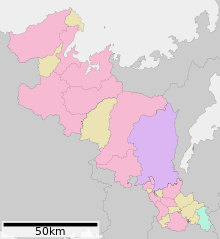
Map of Kyoto Prefecture Government Ordinance Designated City City Town Village
| Historical population | ||
|---|---|---|
| Year | Pop. | ±% |
| 1885 | 846,761 | — |
| 1890 | 894,928 | +5.7% |
| 1900 | 1,022,695 | +14.3% |
| 1910 | 1,197,473 | +17.1% |
| 1920 | 1,287,147 | +7.5% |
| 1930 | 1,552,832 | +20.6% |
| 1940 | 1,729,993 | +11.4% |
| 1950 | 1,832,934 | +6.0% |
| 1960 | 1,993,403 | +8.8% |
| 1970 | 2,250,087 | +12.9% |
| 1980 | 2,527,330 | +12.3% |
| 1990 | 2,602,460 | +3.0% |
| 2000 | 2,644,391 | +1.6% |
| 2010 | 2,636,092 | −0.3% |
| 2015 | 2,610,353 | −1.0% |
| Source: [1] | ||
Kyoto Prefecture is almost in the center of Honshu and of Japan. It covers an area of 4,612.19 square kilometres (1,780.78 sq mi), which is 1.2% of Japan. Kyoto is 31st by size. To the north, it faces the Sea of Japan and Fukui Prefecture. To the south, it faces Osaka and Nara Prefectures. To the east, it faces Mie and Shiga Prefectures. To its west is Hyōgo Prefecture. The prefecture is separated in the middle by the Tanba Mountains. This makes its climate very different in the north and south.
As of 15 April 2016, 21% of the prefecture's land area was designated as Natural Parks, namely Sanin Kaigan National Park; Biwako, Kyoto Tamba Kogen, Tango-Amanohashidate-Ōeyama and Wakasa Wan Quasi-National Parks; and Hozukyō, Kasagiyama, and Rurikei Prefectural Natural Parks.[7]
Cities
Fifteen cities are located in Kyoto Prefecture:
- Ayabe
- Fukuchiyama
- Jōyō
- Kameoka
- Kizugawa
- Kyōtanabe
- Kyōtango
Kyoto (capital)- Maizuru
- Miyazu
- Mukō
- Nagaokakyō
- Nantan
- Uji
- Yawata
Towns and villages
These are the towns and villages in each district:
|
|
|
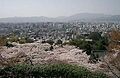
Kyoto City

Uji

Fukuchiyama
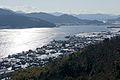
Miyazu and Aso Bay


Mergers
Economy
| Year | US$ |
|---|---|
| 1975 | 4,746 |
| 1980 | 8,375 |
| 1985 | 12,799 |
| 1990 | 18,128 |
| 1995 | 21,190 |
| 2000 | 24,692 |
| 2005 | 29,256 |
| 2010 | 33,058 |
| 2015 | 38,567 |
Kyoto prefecture's economy is supported by industries that create value that is unique to Kyoto, such as the tourism and traditional industries supported by 1,200 years of history and culture, as well as high-technology industries that combine the technology of Kyoto's traditional industries with new ideas.[10]
Northern Kyoto on the Tango Peninsula has fishing and water transportation, and midland Kyoto has agriculture and forestry. The prefecture produces 13% of the domestic sake and green tea. Japan's largest vertical farm is located in the prefecture.[11]
The Kyoto-based manufacturing industry holds shares of Japan's high-technology product markets and others. As of 2018, six Forbes Global 2000 companies were located in Kyoto prefecture: Nidec, Kyocera, Murata Manufacturing, Nintendo, Omron, Bank of Kyoto. Takara Holdings, GS Yuasa, SCREEN Holdings, Mitsubishi Logisnext, Maxell, and Kyoto Animation are based in the prefecture.
As of October 2018, the minimum wage in the prefecture was ¥882 per hour.[12]
Culture
Kyoto has been, and still remains, Japan's cultural center.[13][14] For over 1000 years it was Japan's capital. When the capital was changed to Tokyo, Kyoto remained Japan's cultural capital. The local government proposes a plan to move the Agency for Cultural Affairs to Kyoto and to regard Tokyo as the capital of politics and economy and Kyoto as the capital of culture.[15] See Culture of Japan.
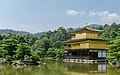
Kinkaku-ji

Ginkaku-ji

Togetsu Bridge in Arashiyama

Heian Shrine
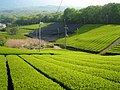
Japanese tea plantation

Rokkaku-dō, where a school of the Japanese flower arrangement originated from.


Education
Universities
- Bukkyo University
- Doshisha University
- Hanazono University
- Heian Jogakuin University
- Kyoto Bunkyo University
- Kyoto City University of Arts
- Kyoto Gakuen University
- Kyoto Institute of Technology
Kyoto Kacho University- Kyoto Koka Women's University
- Kyoto Notre Dame University
- Kyoto Pharmaceutical University
- Kyoto Prefectural University
- Kyoto Prefectural University of Medicine
- Kyoto Saga University of Arts
- Kyoto Sangyo University
- Kyoto Seika University
- Kyoto Tachibana University
- Kyoto University
- Kyoto University of Art and Design
Kyoto Arts and Crafts University- Kyoto University of Education
- Kyoto University of Foreign Studies
- Kyoto Women's University
- Meiji University of Integrative Medicine
- Ōtani University
- Ritsumeikan University
- Ryukoku University
- Seibi University
- Shuchiin University
High schools
- Kyoto Tachibana Senior High School
- Kyoto Tachibana Junior High School
Sports
The sports teams listed below are based in Kyoto.
Football (soccer)
Kyoto Sanga F.C. (J2 League)
Amitie SC Kyoto (Kansai Soccer League)
Bunnys Kyoto SC (Japan Women's Football League)
Basketball
Kyoto Hannaryz (B.League)
Baseball
- Kyoto Flora (Japan Women's Baseball League)
Rugby
Mitsubishi Motors Kyoto Red Evoluitions (Top West)
Transportation

Kyoto Station
Rail
JR Central
Tōkaidō Shinkansen—Kyōto Station
JR West- Kyoto Line
- Biwako Line
- Kosei Line
- Nara Line
Kansai Line (Kizu-Kamo)- Sagano Line
- Sanin Line
- Fukuchiyama Line
- Maizuru Line
- Obama Line
Keihan- Keihan Line
- Uji Line
- Keishin Line
- Outou Line
Hankyu- Kyoto Line
- Arashiyama Line
Kintetsu- Kyoto Line
Kyoto Municipal Subway- Karasuma Line
- Tōzai Line
Sagano Scenic Railway (Arashiyama-Kameoka)
Kyoto Tango Railway- Miyafuku Line
- Miyamai Line
- Miyatoyo Line
City Tram
Randen- Arashiyama Line
- Kitano Line
Eiden- Eizan Line
- Kurama Line
Ports
- Maizuru Port - Mainly international container terminal and ferry route to Hokkaido (Otaru and Tomakomai).
Road
Expressways
- Meishin Expressway
- Hanshin Expressway
- Second Keihan Highway
- Keiji(Kyoto-Shiga) Bypass
- Maizuru Wakasa Expressway
- Keinawa(Kyoto-Nara-Wakayama) Expressway
- Kyoto-Jukan Expressway
National highways
- Route 1
Route 9 (Kyoto-Fukuchiyama-Tottori-Yonago-Izumo-Hamada-Yamaguchi)
Route 24 (Kyoto-Nara-Kashihara-Hashimoto-Wakayama)
Route 27 (Tanba-Maizuru-Tsuruga)- Route 162
- Route 163
Route 171 (Kyoto-Takatsuki-Minoo-Itami-Nishinomiya)- Route 173
Route 175 (Akashi-Nishiwaki-Fukuchiyama-Maizuru)
Route 176 (Osaka-Sanda-Sasayama-Fukuchiyama-Miyazu)- Route 178
- Route 307
- Route 312
Route 372 (Kameoka-Sasayama-Kasai-Himeji)- Route 423
- Route 426
- Route 429
- Route 477
- Route 478
Tourism
The city of Kyoto is one of the most popular tourist spots in Japan, and many people from far and wide visit there. Along with Tokyo, Kyoto is a favorite location for the graduation trip of Junior High and High schools.
Some of the festivals held in Kyoto are Aoi Matsuri from 544, Gion Matsuri from 869, Ine Matsuri from the Edo-era, Daimonji Gozan Okuribi from 1662, and Jidai Matsuri from 1895. Every shrine and temple holds some sort of event, and many of them are open for public viewing.
Defense facilities
On August 1, 2013, prefectural and municipal authorities gave consent for a USFJ missile monitoring station to be set up in the city of Kyōtango. It will be co-located with a JASDF facility already based in the city. At least initially, its primary sensor will be a mobile X-band radar used to gather data on ballistic missile launches which will then be relayed by the station to warships equipped with Aegis air defense systems and to ground-based interceptor missile sites. A hundred and sixty personnel will be based at the station.[16]
Politics
The current governor of Kyoto is Takatoshi Nishiwaki, a former vice minister of the Reconstruction Agency. He has been elected in April 2018.[17]
The previous governor of Kyoto is former Home Affairs Ministry bureaucrat Keiji Yamada. He has been reelected to a fourth term in April 2014 with support from the major non-Communist parties against only one JCP-supported challenger.[18][19][20]
The prefectural assembly has 60 members from 25 electoral districts and is still elected in unified local elections (last round: 2011). As of September 2013, it was composed as follows: Liberal Democratic Party 25, Democratic Party 14, Japanese Communist Party 11, Kōmeitō 5, Kyōto sōsei forum 1, Japan Restoration Party 1.[21]
Kyoto's delegation to the National Diet consists of six members of the House of Representatives and four members (two per election) of the House of Councillors. After the national elections of 2010, 2012 and 2013, the prefecture is represented by four Liberal Democrats and two Democrats in the lower house, and two Liberal Democrats, one Democrat and one Communist in the upper house.
Prefectural symbols
The prefectural flower of Kyoto is the weeping cherry. The Kitayama Sugi is the official tree, and the streaked shearwater the bird that symbolizes the prefecture.
Sister areas
Kyoto Prefecture has sister relationships with these places:[22]
 Shaanxi Province, China
 Yogyakarta Special Region, Indonesia[23]
 Oklahoma, United States
 Leningrad Oblast, Russia
 Edinburgh, Scotland, United Kingdom[24][25]
 Occitanie, France
 Quebec, Canada[26]


These relationships are distinct from those of cities in Kyoto Prefecture with other cities.
Notes
^ Nussbaum, Louis-Frédéric. (2005). "Kyoto-fu" in Japan Encyclopedia, p. 587, p. 587, at Google Books; "Kansai" in Japan Encyclopedia, p. 477, p. 477, at Google Books.
^ Nussbaum, "Kyoto" in Japan Encyclopedia, pp. 565-587, p. 585, at Google Books.
^ Nussbaum, "Provinces and prefectures" in p. 780, p. 780, at Google Books.
^ Manansala, Paul Kekai (5 September 2006). "Quests of the Dragon and Bird Clan: Luzon Jars (Glossary)"..mw-parser-output cite.citationfont-style:inherit.mw-parser-output .citation qquotes:"""""""'""'".mw-parser-output .citation .cs1-lock-free abackground:url("//upload.wikimedia.org/wikipedia/commons/thumb/6/65/Lock-green.svg/9px-Lock-green.svg.png")no-repeat;background-position:right .1em center.mw-parser-output .citation .cs1-lock-limited a,.mw-parser-output .citation .cs1-lock-registration abackground:url("//upload.wikimedia.org/wikipedia/commons/thumb/d/d6/Lock-gray-alt-2.svg/9px-Lock-gray-alt-2.svg.png")no-repeat;background-position:right .1em center.mw-parser-output .citation .cs1-lock-subscription abackground:url("//upload.wikimedia.org/wikipedia/commons/thumb/a/aa/Lock-red-alt-2.svg/9px-Lock-red-alt-2.svg.png")no-repeat;background-position:right .1em center.mw-parser-output .cs1-subscription,.mw-parser-output .cs1-registrationcolor:#555.mw-parser-output .cs1-subscription span,.mw-parser-output .cs1-registration spanborder-bottom:1px dotted;cursor:help.mw-parser-output .cs1-ws-icon abackground:url("//upload.wikimedia.org/wikipedia/commons/thumb/4/4c/Wikisource-logo.svg/12px-Wikisource-logo.svg.png")no-repeat;background-position:right .1em center.mw-parser-output code.cs1-codecolor:inherit;background:inherit;border:inherit;padding:inherit.mw-parser-output .cs1-hidden-errordisplay:none;font-size:100%.mw-parser-output .cs1-visible-errorfont-size:100%.mw-parser-output .cs1-maintdisplay:none;color:#33aa33;margin-left:0.3em.mw-parser-output .cs1-subscription,.mw-parser-output .cs1-registration,.mw-parser-output .cs1-formatfont-size:95%.mw-parser-output .cs1-kern-left,.mw-parser-output .cs1-kern-wl-leftpadding-left:0.2em.mw-parser-output .cs1-kern-right,.mw-parser-output .cs1-kern-wl-rightpadding-right:0.2em
^ Oi, Mariko (2015-08-09). "The city saved from the atomic bomb". Retrieved 2019-01-16.
^ Chronology of the Occupation
^ "General overview of area figures for Natural Parks by prefecture" (PDF) (in Japanese). Ministry of the Environment. 15 April 2016. Retrieved 12 June 2016.
^ "県民経済計算" (in Japanese). Cabinet Office (Japan). Retrieved 2017-10-16.
^ "Purchasing power parities (PPP)". OECD. Retrieved 2017-10-16.
^ "Kyoto Prefecture Financial Profile and Fiscal Reforms" (PDF). October 2017. Retrieved 2018-05-17.
^ "The only way is up: Vertical farming in Kyoto". CNN. 19 September 2016.
^ "地域別最低賃金の全国一覧" [List of minimum wages by region] (in Japanese). Ministry of Health, Labour and Welfare. Retrieved 8 September 2018.
^ Kyoto | History, Geography, & Points of Interest | Britannica.com
^ Shinzō Abe (18 November 2018). Committee on Budget. The 190th ordinary session of the Diet (in Japanese). 8. House of Representatives.京都というのは文化的な中心
^ Shigefumi Matsuzawa (7 June 2018). Committee on Education, Culture and Science. The 196th ordinary session of the Diet (in Japanese). 14. House of Councillors.政治経済の首都東京に対して文化の首都京都をつくっていく、そういう双眼構造、二元構造にする
^ U.S. to deploy mobile radar in Kyoto Prefecture to detect missile launches The Asahi Shimbun, August 2nd, 2013
^ "Nishiwaki triumphs in Kyoto gubernatorial race, vows to continue policies of predecessor". The Japan Times. April 8, 2018.
^ Asahi Shimbun, April 6, 2014: 京都知事に山田氏、4選 新顔の尾崎氏破る
^ Yomiuri Shimbun, April 6, 2014: 京都府知事選、現職の山田啓二氏が4選
^ The Japan Times, April 7, 2014: Kyoto re-elects Yamada to top post
^ Kyoto Prefectural Assembly: caucuses (in Japanese)
^
International Exchange: Regions with Friendly Ties to Kyoto Prefecture Retrieved November 29, 2015
^ "Peringatan 25 Tahun Sister City Kyoto-Yogya, Kedua Kota Mendapat Manfaat" (in Indonesian). Koran Tempo. October 6, 2010. Retrieved May 20, 2014.
^ "Edinburgh – Twin and Partner Cities". 2008 The City of Edinburgh Council, City Chambers, High Street, Edinburgh, EH1 1YJ Scotland. Archived from the original on 28 March 2008. Retrieved 21 December 2008.
^ "Twin and Partner Cities". City of Edinburgh Council. Archived from the original on 14 June 2012. Retrieved 16 January 2009.
^ "Communiqué du 26 mai 2016 – Signature d'une première entente de collaboration entre le Québec et la préfecture de Kyoto". www.premier-ministre.gouv.qc.ca.
References
- Nussbaum, Louis-Frédéric and Käthe Roth. (2005). Japan encyclopedia. Cambridge: Harvard University Press.
ISBN 978-0-674-01753-5; OCLC 58053128
External links
 | Wikimedia Commons has media related to Kyoto prefecture. |
- Official Kyoto Prefecture website
- Kyoto Prefectural International Center
- Kyoto Prefecture Tourism Guide
- Kyoto Visitors Guide
 Kyoto Prefecture travel guide from Wikivoyage
 Kyoto Prefecture travel guide from Wikivoyage
 Kyoto Prefecture Kyoto Prefecture | ||
|---|---|---|
Kyoto (capital) | ||
Wards of Kyoto |
|  |
| Cities |
| |
| Districts |
| |
List of mergers in Kyoto Prefecture | ||
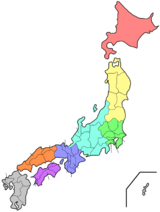
 Regions and administrative divisions of Japan Regions and administrative divisions of Japan | |||||||||||||||||
|---|---|---|---|---|---|---|---|---|---|---|---|---|---|---|---|---|---|
| Regions |
|  | |||||||||||||||
| 47 Prefectures |
| ||||||||||||||||
Authority control  |
|
|---|


