Cephalopod limb
@media all and (max-width:720px).mw-parser-output .tmulti>.thumbinnerwidth:100%!important;max-width:none!important.mw-parser-output .tmulti .tsinglefloat:none!important;max-width:none!important;width:100%!important;text-align:center


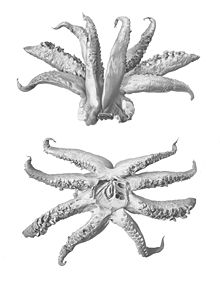
Arms and buccal mass of the squid Taningia danae. As in other Octopoteuthidae, the tentacles are absent in adults.

Oral view of the bobtail squid Semirossia tenera

Head and limbs of the bobtail squid Rossia glaucopis

Oral view of male Bathypolypus arcticus with hectocotylus on arm III (left)

Cephalopod suckers and configuration of suckers on tentacular club

Serrated suckers of a giant squid

Octopus arm with two rows of suckers

Octopus suckers
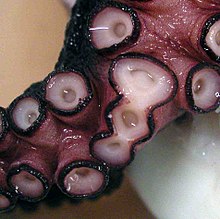
A deformed octopus sucker cluster

A common octopus with a forked arm that was found in south Crete, Greece
All cephalopods possess flexible limbs extending from their heads and surrounding their beaks. These appendages, which function as muscular hydrostats, have been variously termed arms, legs or tentacles.[A]
Contents
1 Description
2 Suckers
3 Abnormalities
4 Variability
4.1 Arms
4.2 Tentacular clubs
4.3 Suckers
5 References
5.1 Notes
5.2 Citations
Description
In the scientific literature, a cephalopod arm is often treated as distinct from a tentacle, though the terms are sometimes used interchangeably. Generally, arms have suckers along most of their length, as opposed to tentacles, which have suckers only near their ends.[4] Barring a few exceptions, octopuses have eight arms and no tentacles, while squid and cuttlefish have eight arms (or two "legs" and six "arms") and two tentacles.[5] The limbs of nautiluses, which number around 90 and lack suckers altogether, are called tentacles.[5][6][7]
The tentacles of Decapodiformes are thought to be derived from the fourth arm pair of the ancestral coleoid, but the term arms IV is used to refer to the subsequent, ventral arm pair in modern animals (which is evolutionarily the fifth arm pair).[4]
The males of most cephalopods develop a specialised arm for sperm delivery, the hectocotylus.
Anatomically, cephalopod limbs function using a crosshatch of helical collagen fibres in opposition to internal muscular hydrostatic pressure.[8][better source needed]
Suckers
Cephalopod limbs bear numerous suckers along their ventral surface as in octopus, squid and cuttlefish arms, or in clusters at the ends of the tentacles, as in squid and cuttlefish.[9] Each sucker is usually circular and bowl-like and has two distinct parts: an outer shallow cavity called an infundibulum and a central hollow cavity called an acetabulum. Both of these structures are thick muscles, and are covered with a chitinous cuticle to make a protective surface.[10] Suckers are used for grasping substratum, catching prey and for locomotion. When a sucker attaches itself to an object, the infundibulum mainly provides adhesion while the central acetabulum is free. Sequential muscle contraction of the infundibulum and acetabulum causes attachment and detachment.[11][12]
Abnormalities
Many octopus arm anomalies have been recorded,[13][14] including a 6-armed octopus (nicknamed Henry the Hexapus), a 7-armed octopus,[15] a 10-armed Octopus briareus,[16] one with a forked arm tip,[17] octopuses with double or bilateral hectocotylization,[18][19] and specimens with up to 96 arm branches.[20][21][22]
Branched arms and other limb abnormalities have also been recorded in cuttlefish,[23]squid,[24] and bobtail squid.[25]
Variability
Cephalopod limbs and the suckers they bear are shaped in many distinctive ways, and vary considerably between species. Some examples are shown below.
Arms
For hectocotylized arms see hectocotylus variability.
| Shape of arm | Species | Family |
|---|---|---|
 | Todarodes pacificus | Ommastrephidae |
Tentacular clubs
| Shape of tentacular club | Species | Family |
|---|---|---|
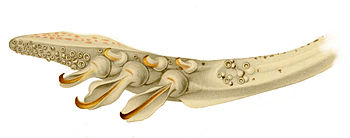 | Abraliopsis morisi | Enoploteuthidae |
 | Ancistroteuthis lichtensteini | Onychoteuthidae |
 | Architeuthis sp. | Architeuthidae |
 | Austrorossia mastigophora | Sepiolidae |
 | Berryteuthis magister | Gonatidae |
 | Idioteuthis cordiformis | Mastigoteuthidae |
 | Iridoteuthis iris | Sepiolidae |
 | Mastigoteuthis glaukopis | Mastigoteuthidae |
 | Onykia ingens | Onychoteuthidae |
 | Semirossia tenera | Sepiolidae |
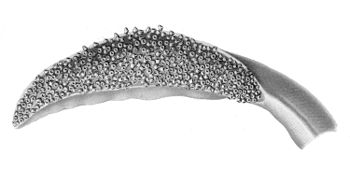 | Spirula spirula | Spirulidae |
 | Todarodes pacificus | Ommastrephidae |
Suckers
| Shape of sucker | Species | Family |
|---|---|---|
 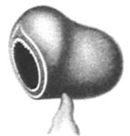  | Idioteuthis cordiformis | Mastigoteuthidae |
  | Idioteuthis latipinna | Mastigoteuthidae |
  | Magnapinna talismani | Magnapinnidae |
 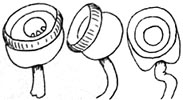 | Mastigoteuthis agassizii | Mastigoteuthidae |
  | Mastigoteuthis atlantica | Mastigoteuthidae |
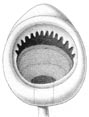 | Mastigoteuthis dentata | Mastigoteuthidae |
 | Mastigoteuthis grimaldii | Mastigoteuthidae |
 | Mastigoteuthis magna | Mastigoteuthidae |
References
Notes
^ A study has determined that the octopus has two arms and six legs, often commonly and erroneously referred to as "tentacles". [1] Another study found that there is a functional difference in the way the appendages are used for task division. "These findings give evidence for limb-specialization in an animal whose 8 arms were believed to be equipotential."[2] The two rear appendages are generally used to walk on the sea floor, while the other six are used to forage for food.[3]
Citations
^ Thomas, David (12 August 2008). "Octopuses have two legs and six arms". The Telegraph. Retrieved 30 July 2018.To most of us it has always seemed obvious that an octopus has eight arms. Octopuses have two legs and six arms Claire Little, a marine expert from the Weymouth Sea Life Centre in Dorset, said: 'We've found that octopuses effectively have six arms and two legs.'
.mw-parser-output cite.citationfont-style:inherit.mw-parser-output .citation qquotes:"""""""'""'".mw-parser-output .citation .cs1-lock-free abackground:url("//upload.wikimedia.org/wikipedia/commons/thumb/6/65/Lock-green.svg/9px-Lock-green.svg.png")no-repeat;background-position:right .1em center.mw-parser-output .citation .cs1-lock-limited a,.mw-parser-output .citation .cs1-lock-registration abackground:url("//upload.wikimedia.org/wikipedia/commons/thumb/d/d6/Lock-gray-alt-2.svg/9px-Lock-gray-alt-2.svg.png")no-repeat;background-position:right .1em center.mw-parser-output .citation .cs1-lock-subscription abackground:url("//upload.wikimedia.org/wikipedia/commons/thumb/a/aa/Lock-red-alt-2.svg/9px-Lock-red-alt-2.svg.png")no-repeat;background-position:right .1em center.mw-parser-output .cs1-subscription,.mw-parser-output .cs1-registrationcolor:#555.mw-parser-output .cs1-subscription span,.mw-parser-output .cs1-registration spanborder-bottom:1px dotted;cursor:help.mw-parser-output .cs1-ws-icon abackground:url("//upload.wikimedia.org/wikipedia/commons/thumb/4/4c/Wikisource-logo.svg/12px-Wikisource-logo.svg.png")no-repeat;background-position:right .1em center.mw-parser-output code.cs1-codecolor:inherit;background:inherit;border:inherit;padding:inherit.mw-parser-output .cs1-hidden-errordisplay:none;font-size:100%.mw-parser-output .cs1-visible-errorfont-size:100%.mw-parser-output .cs1-maintdisplay:none;color:#33aa33;margin-left:0.3em.mw-parser-output .cs1-subscription,.mw-parser-output .cs1-registration,.mw-parser-output .cs1-formatfont-size:95%.mw-parser-output .cs1-kern-left,.mw-parser-output .cs1-kern-wl-leftpadding-left:0.2em.mw-parser-output .cs1-kern-right,.mw-parser-output .cs1-kern-wl-rightpadding-right:0.2em
^ Ruth A., Byrne; Kuba, Michael J.; Meisel, Daniela V.; Griebel, Ulrike; Mather, Jennifer A. (August 2006). "Does Octopus vulgaris have preferred arms?". Journal of Comparative Psychology. American Psychological Association. 120 (3): 198–204. Retrieved July 30, 2018.
^ Lloyd, John; Mitchinson, John (2010). QI: The Second Book of General Ignorance. London: Faber and Faber. p. 3. ISBN 0571273750.As result, marine biologists tend to refer to them as animals with two legs and six arms.
^ ab Young, R.E., M. Vecchione & K.M. Mangold 1999. Cephalopoda Glossary. Tree of Life web project.
^ ab Norman, M. 2000. Cephalopods: A World Guide. ConchBooks, Hackenheim. p. 15. "There is some confusion around the terms arms versus tentacles. The numerous limbs of nautiluses are called tentacles. The ring of eight limbs around the mouth in cuttlefish, squids and octopuses are called arms. Cuttlefish and squid also have a pair of specialised limbs attached between the bases of the third and fourth arm pairs [...]. These are known as feeding tentacles and are used to shoot out and grab prey."
^ Fukuda, Y. 1987. Histology of the long digital tentacles. In: W.B. Saunders & N.H. Landman (eds.) Nautilus: The Biology and Paleobiology of a Living Fossil. Springer Netherlands. pp. 249–256. doi:10.1007/978-90-481-3299-7_17
^ Kier, W.M. 1987. "The functional morphology of the tentacle musculature of Nautilus pompilius" (PDF). In: W.B. Saunders & N.H. Landman (eds.) Nautilus: The Biology and Paleobiology of a Living Fossil. Springer Netherlands. pp. 257–269. doi:10.1007/978-90-481-3299-7_18
^ Inside natures giants, Giant squid episode.
^ von Byern J, Klepal W (2005). "Adhesive mechanisms in cephalopods: a review". Biofouling. 22 (5–6): 329–38. doi:10.1080/08927010600967840. PMID 17110356.
^ Walla G (2007). "A study of the Comparative Morphology of Cephalopod Armature". tonmo.com. Deep Intuition, LLC. Retrieved 2013-06-08.
^ Kier WM, Smith AM (2002). "The structure and adhesive mechanism of octopus suckers". Integr Comp Biol. 42 (6): 1146–1153. doi:10.1093/icb/42.6.1146. PMID 21680399.
^ Octopuses & Relatives. "Learn about octopuses & relatives: locomotion". asnailsodyssey.com. Archived from the original on 2013-05-22. Retrieved 2013-06-08.
^ Kumph H.E. (1960). "Arm abnormality in octopus". Nature. 185 (4709): 334–335. doi:10.1038/185334a0.
^ Toll R.B., Binger L.C. (1991). "Arm anomalies: cases of supernumerary development and bilateral agenesis of arm pairs in Octopoda (Mollusca, Cephalopoda)". Zoomorphology. 110 (6): 313–316. doi:10.1007/BF01668021.
^ Gleadall I.G. (1989). "An octopus with only seven arms: anatomical details". Journal of Molluscan Studies. 55 (4): 479–487. doi:10.1093/mollus/55.4.479.
^ Minor birth defect resulting in 10-armed juvenile, all arms fully present and functional.[permanent dead link] CephBase.
^ Minor birth defect showing bifurcated arm tip. Both tips were fully functional.[permanent dead link] CephBase.
^ Robson G.C. (1929). "On a case of bilateral hectocotylization in Octopus rugosus". Journal of Zoology. 99 (1): 95–97. doi:10.1111/j.1469-7998.1929.tb07690.x.
^ Palacio, F.J. 1973. "On the double hectocotylization of octopods".
The Nautilus 87: 99–102.
^ Okada Y.K. (1965). "On Japanese octopuses with branched arms, with special reference to their captures from 1884 to 1964". Proceedings of the Japan Academy. 41 (7): 618–623.
[permanent dead link]
^ Okada Y.K. (1965). "Rules of arm-branching in Japanese octopuses with branched arms". Proceedings of the Japan Academy. 41 (7): 624–629.
[permanent dead link]
^ Monster octopi with scores of extra tentacles. Pink Tentacle, July 18, 2008.
^ Okada Y.K. (1937). "An occurrence of branched arms in the decapod cephalopod, Sepia esculenta Hoyle". Annotated Zoology of Japan. 17: 93–94.
^ Bradbury H.E., Aldrich F.A. (1971). "The occurrence of morphological abnormalities in the oegopsid squid Illex illecebrosus (Lesueur, 1821)". Canadian Journal of Zoology. 49 (3): 377–379. doi:10.1139/z71-055.
^ Voss G.L. (1957). "Observations on abnormal growth of the arms and tentacles in the squid genus Rossia". The Quarterly Journal of the Florida Academy of Sciences. 20 (2): 129–132.
Cephalopod anatomy | |||||||||
|---|---|---|---|---|---|---|---|---|---|
| Shell |
|    | |||||||
Mantle and funnel |
| ||||||||
| Head and limbs |
| ||||||||
| General |
| ||||||||
Developmental stages: Spawn → Paralarva (Doratopsis stage) → Juvenile → Subadult → Adult • Egg fossils • Protoconch (embryonic shell) | |||||||||


