Secretary of State for Northern Ireland
| Secretary of State for Northern Ireland | |
|---|---|
 Royal Arms of Her Majesty's Government | |
 Incumbent Karen Bradley since 8 January 2018 | |
| Northern Ireland Office | |
| Style | Northern Ireland Secretary (informal) The Right Honourable (within the UK and the Commonwealth) |
| Residence | Hillsborough Castle |
| Appointer | The Monarch on advice of the Prime Minister |
| Precursor | Lord Lieutenant of Ireland Governor of Northern Ireland |
| Formation | 24 March 1972 |
| First holder | William Whitelaw |
| Website | www.nio.gov.uk |
Northern Ireland |
|---|
 |
This article is part of a series on the politics and government of Northern Ireland |
Executive
a Lowercase "d" per here. |
Assembly
|
Law
|
Northern Ireland in the UK
|
Northern Ireland in the EU
|
Local government
|
|
United Kingdom |
|---|
 |
This article is part of a series on the politics and government of the United Kingdom |
Constitution
|
The Crown British Monarchy
|
Executive HM Government
Privy Council
|
Legislature Parliament (56th Parliament) Crown-in-Parliament
House of Lords
House of Commons
|
Judiciary Supreme Court
|
Devolution
Scotland
Wales
Northern Ireland
England
|
Administrative geography
|
Elections
General Elections
Referendums
|
Crown Dependencies
|
Overseas Territories
|
Foreign relations
|
 United Kingdom portal United Kingdom portal
|


Her Majesty's Principal Secretary of State for Northern Ireland, informally known as the Northern Ireland Secretary (Irish: Rúnaí Stáit Thuaisceart Éireann[1][2]), is the principal secretary of state in Her Majesty's Government with responsibilities for Northern Ireland. The Secretary of State is a Minister of the Crown who is accountable to the Parliament of the United Kingdom and is the chief minister in the Northern Ireland Office. As with other ministers, the position is appointed by the British monarch on the advice of the Prime Minister.
The position is normally described simply as 'the Secretary of State' by residents of Northern Ireland.[citation needed]
Formerly holding a large portfolio over home affairs in Northern Ireland, the current devolution settlement has lessened the Secretary of State's role, granting many of the former powers to the Northern Ireland Assembly and Northern Ireland Executive. The Secretary of State is now generally limited to representing Northern Ireland in the UK cabinet, overseeing the operation of the devolved administration and a number of reserved and excepted matters which remain the sole competence of the UK Government e.g. security, human rights, certain public inquiries and the administration of elections.[3]
Created in 1972, the position has switched between Members of Parliament from the Conservative Party and Labour Party. As Labour has not fielded candidates in Northern Ireland and the Conservatives have not had candidates elected to Northern Ireland Assembly or for House of Commons seats in the province, those appointed as Secretary of State for Northern Ireland have not represented a constituency in Northern Ireland. This contrasts with the Secretary of State for Scotland and the Secretary of State for Wales.
The Secretary of State resides in Hillsborough Castle, which was previously the official residence of the Governor of Northern Ireland, and remains the royal residence of the Monarch in Northern Ireland.
The Secretary of State exercises their duties through, and is administratively supported by, the Northern Ireland Office.
Contents
1 History
2 List of Secretaries of State for Northern Ireland
3 See also
4 Notes
History
Historically, the principal ministers for Irish (and subsequently Northern Ireland) affairs in the UK Government and its predecessors were:
- the Lord Lieutenant of Ireland (c.1171–1922);
- the Chief Secretary for Ireland (1560–1922); and
- the Home Secretary (1922–1972).[4]
In August 1969, for example, Home Secretary James Callaghan approved the sending of British Army soldiers to Northern Ireland.[5] Scotland and Wales were represented by the Secretary of State for Scotland and Secretary of State for Wales from 1885 and 1965 respectively but Northern Ireland remained separate, due to the devolved Northern Ireland Government and Northern Ireland Parliament.
The office of Secretary of State for Northern Ireland was created after the Northern Ireland government (at Stormont) was first suspended and then abolished following widespread civil strife. The British government was increasingly concerned that Stormont was losing control of the situation. On 30 March 1972, direct rule from Westminster was introduced.[6] The Secretary of State filled three roles which existed under the previous Stormont regime:[7]
- the Governor of Northern Ireland (the nominal head of the executive and representative of the British monarch)
- the Prime Minister of Northern Ireland (now filled by the First Minister of Northern Ireland and deputy First Minister of Northern Ireland acting jointly)
- the Minister of Home Affairs (now filled by the Minister of Justice).
Direct rule was seen as a temporary measure, with a power-sharing devolution preferred as the solution, and was annually renewed by a vote in Parliament.
The Sunningdale Agreement in 1973 resulted in a brief, power-sharing Northern Ireland Executive, from 1 January 1974, which was ended by the loyalist Ulster Workers' Council strike on 28 May 1974. The strikers opposed the power-sharing and all-Ireland aspects of the new administration.
The Northern Ireland Constitutional Convention (1975–1976) and Northern Ireland Assembly (1982–1986) were unsuccessful in restoring devolved government. After the Anglo-Irish Agreement on 15 November 1985, the UK Government and Irish Government co-operated more closely on security and political matters.
Following the Belfast Agreement (also known as the Good Friday Agreement) on 10 April 1998, devolution returned to Northern Ireland on 2 December 1999. This removed many of the duties of the Secretary of State and his Northern Ireland Office colleagues and devolved them to locally elected politicians, constituting the Northern Ireland Executive.
The devolved administration was suspended several times (especially between 15 October 2002 and 8 May 2007) because the Ulster Unionist Party and Democratic Unionist Party were uncomfortable being in government with Sinn Féin when the Provisional Irish Republican Army had failed to decommission its arms fully and continued its criminal activities. On each of these occasions, the responsibilities of the ministers in the Executive then returned to the Secretary of State and his ministers. During these periods, in addition to administration of the region, the Secretary of State was also heavily involved in the negotiations with all parties to restore devolved government.
Power was again devolved to the Northern Ireland Assembly on 8 May 2007. The Secretary of State retained responsibility for policing and justice until most of those powers were devolved on 12 April 2010.[8]
List of Secretaries of State for Northern Ireland
Colour key
Conservative
Labour
| Portrait | Name | Term of office | Party | Prime Minister | |||
|---|---|---|---|---|---|---|---|
 | William Whitelaw MP for Penrith and The Border | 24 March 1972 | 2 December 1973 | Conservative | Edward Heath | ||
 | Francis Pym MP for Cambridgeshire | 2 December 1973 | 4 March 1974 | Conservative | |||
 | Merlyn Rees MP for Leeds South | 5 March 1974 | 10 September 1976 | Labour | Harold Wilson | ||
| Roy Mason MP for Barnsley | 10 September 1976 | 4 May 1979 | Labour | James Callaghan | ||
| Humphrey Atkins MP for Spelthorne | 5 May 1979 | 14 September 1981 | Conservative | Margaret Thatcher | ||
| Jim Prior MP for Lowestoft (until 1983) MP for Waveney (from 1983) | 14 September 1981 | 11 September 1984 | Conservative | |||
 | Douglas Hurd MP for Witney | 11 September 1984 | 3 September 1985 | Conservative | |||
 | Tom King MP for Bridgwater | 3 September 1985 | 24 July 1989 | Conservative | |||
| Peter Brooke MP for Cities of London and Westminster South | 24 July 1989 | 10 April 1992 | Conservative | |||
John Major | |||||||
| Sir Patrick Mayhew MP for Tunbridge Wells | 10 April 1992 | 2 May 1997 | Conservative | |||
| Mo Mowlam MP for Redcar | 3 May 1997 | 11 October 1999 | Labour | Tony Blair | ||
 | Peter Mandelson MP for Hartlepool | 11 October 1999 | 24 January 2001 | Labour | |||
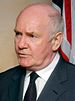 | John Reid MP for Hamilton North and Bellshill | 25 January 2001 | 24 October 2002 | Labour | |||
 | Paul Murphy MP for Torfaen | 24 October 2002 | 6 May 2005 | Labour | |||
 | Peter Hain MP for Neath (also Welsh Secretary) | 6 May 2005 | 27 June 2007 | Labour | |||
 | Shaun Woodward MP for St Helens South | 28 June 2007 | 11 May 2010 | Labour | Gordon Brown | ||
 | Owen Paterson MP for North Shropshire | 12 May 2010 | 4 September 2012 | Conservative | David Cameron (Coalition) | ||
 | Theresa Villiers MP for Chipping Barnet | 4 September 2012 | 14 July 2016 | Conservative | |||
David Cameron (II) | |||||||
 | James Brokenshire MP for Old Bexley and Sidcup | 14 July 2016 | 8 January 2018 | Conservative | Theresa May | ||
 | Karen Bradley MP for Staffordshire Moorlands | 8 January 2018 | Incumbent | Conservative | |||
See also
- First Minister of Northern Ireland
- Great Seal of Northern Ireland
- Shadow Secretary of State for Northern Ireland
- Secretary of State (United Kingdom)
- Secretary of State for Scotland
- Secretary of State for Wales
Notes
^ Affairs, Department of Foreign. "Buaileann an Tánaiste le Rúnaí Stáit Thuaisceart Éireann - An Roinn Gnóthaí Eachtracha agus Trádála". www.dfa.ie..mw-parser-output cite.citationfont-style:inherit.mw-parser-output qquotes:"""""""'""'".mw-parser-output code.cs1-codecolor:inherit;background:inherit;border:inherit;padding:inherit.mw-parser-output .cs1-lock-free abackground:url("//upload.wikimedia.org/wikipedia/commons/thumb/6/65/Lock-green.svg/9px-Lock-green.svg.png")no-repeat;background-position:right .1em center.mw-parser-output .cs1-lock-limited a,.mw-parser-output .cs1-lock-registration abackground:url("//upload.wikimedia.org/wikipedia/commons/thumb/d/d6/Lock-gray-alt-2.svg/9px-Lock-gray-alt-2.svg.png")no-repeat;background-position:right .1em center.mw-parser-output .cs1-lock-subscription abackground:url("//upload.wikimedia.org/wikipedia/commons/thumb/a/aa/Lock-red-alt-2.svg/9px-Lock-red-alt-2.svg.png")no-repeat;background-position:right .1em center.mw-parser-output .cs1-subscription,.mw-parser-output .cs1-registrationcolor:#555.mw-parser-output .cs1-subscription span,.mw-parser-output .cs1-registration spanborder-bottom:1px dotted;cursor:help.mw-parser-output .cs1-hidden-errordisplay:none;font-size:100%.mw-parser-output .cs1-visible-errorfont-size:100%.mw-parser-output .cs1-subscription,.mw-parser-output .cs1-registration,.mw-parser-output .cs1-formatfont-size:95%.mw-parser-output .cs1-kern-left,.mw-parser-output .cs1-kern-wl-leftpadding-left:0.2em.mw-parser-output .cs1-kern-right,.mw-parser-output .cs1-kern-wl-rightpadding-right:0.2em
^ "'Níl sé de cheart ag Brokenshire an Riail Dhíreach a thabhairt ar ais agus ní ghlacfaimis léi' – Sinn Féin". Archived from the original on 2017-04-18.
^ "Archived copy". Archived from the original on 17 September 2010. Retrieved 19 June 2010.CS1 maint: Archived copy as title (link)
^ "Home Office". National Archives Catalogue. National Archives. Retrieved 15 October 2011.
^ Melaugh, Martin. "The Deployment of British Troops – 14 August 1969". Conflict Archive on the Internet (CAIN). University of Ulster. Retrieved 15 October 2011.
^ Melaugh, Martin. "A Chronology of the Conflict – 1972". Conflict Archive on the Internet (CAIN). University of Ulster. Retrieved 15 October 2011.
^ "Northern Ireland (Temporary Provisions) Act 1972" (PDF). legislation.gov.uk.
^ Mark Simpson (12 April 2010). "New era for policing and justice in Northern Ireland". BBC News. Retrieved 11 April 2010.
Northern Ireland Office | ||
|---|---|---|
Headquarters: 11 Millbank, London and Stormont House, Belfast | ||
| Secretary of State |
|  |
| Under-Secretary of State |
| |
| Advocate General |
| |
Secretaries of State for Northern Ireland | ||
|---|---|---|
Northern Ireland Office | ||
| | |
*Also held Secretary of State for Wales Opposition Shadow Secretary of State for Northern Ireland | ||
 Cabinet of the United Kingdom Cabinet of the United Kingdom | ||
|---|---|---|
| Great Offices of State |
| |
| Other Cabinet posts |
| |
| Also attend Cabinet |
| |


