33rd United States Congress
| 33rd United States Congress | |
|---|---|
32nd ← → 34th | |
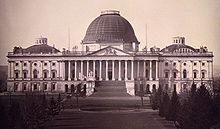 United States Capitol (1846) | |
| March 4, 1853 – March 4, 1855 | |
| Senate President | William R. King (D) until April 18, 1853 Vacant from April 18, 1853 |
| Senate President pro tem | David R. Atchison (D) Lewis Cass (D) Jesse D. Bright (D) |
| House Speaker | Linn Boyd (D) |
| Members | 62 senators 234 members of the House 7 non-voting delegates |
| Senate Majority | Democratic |
| House Majority | Democratic |
| Sessions | |
Special: March 4, 1853 – April 11, 1853 1st: December 5, 1853 – August 7, 1854 2nd: December 4, 1854 – March 4, 1855 | |
The Thirty-third United States Congress was a meeting of the legislative branch of the United States federal government, consisting of the United States Senate and the United States House of Representatives. It met in Washington, D.C. from March 4, 1853, to March 4, 1855, during the first two years of the administration of U.S. President Franklin Pierce. During this session, the Kansas–Nebraska Act was passed, an act that soon led to the creation of the Republican Party. The apportionment of seats in the House of Representatives was based on the Seventh Census of the United States in 1850. Both chambers had a Democratic majority.
.mw-parser-output .toclimit-2 .toclevel-1 ul,.mw-parser-output .toclimit-3 .toclevel-2 ul,.mw-parser-output .toclimit-4 .toclevel-3 ul,.mw-parser-output .toclimit-5 .toclevel-4 ul,.mw-parser-output .toclimit-6 .toclevel-5 ul,.mw-parser-output .toclimit-7 .toclevel-6 uldisplay:none
Contents
1 Major events
2 Major legislation
3 Treaties
4 Territories organized
5 Party summary
5.1 Senate
5.2 House of Representatives
6 Leadership
6.1 Senate
6.2 House of Representatives
7 Members
7.1 Senate
7.1.1 Alabama
7.1.2 Arkansas
7.1.3 California
7.1.4 Connecticut
7.1.5 Delaware
7.1.6 Florida
7.1.7 Georgia
7.1.8 Illinois
7.1.9 Indiana
7.1.10 Iowa
7.1.11 Kentucky
7.1.12 Louisiana
7.1.13 Maine
7.1.14 Maryland
7.1.15 Massachusetts
7.1.16 Michigan
7.1.17 Mississippi
7.1.18 Missouri
7.1.19 New Hampshire
7.1.20 New Jersey
7.1.21 New York
7.1.22 North Carolina
7.1.23 Ohio
7.1.24 Pennsylvania
7.1.25 Rhode Island
7.1.26 South Carolina
7.1.27 Tennessee
7.1.28 Texas
7.1.29 Vermont
7.1.30 Virginia
7.1.31 Wisconsin
7.2 House of Representatives
7.2.1 Alabama
7.2.2 Arkansas
7.2.3 California
7.2.4 Connecticut
7.2.5 Delaware
7.2.6 Florida
7.2.7 Georgia
7.2.8 Illinois
7.2.9 Indiana
7.2.10 Iowa
7.2.11 Kentucky
7.2.12 Louisiana
7.2.13 Maine
7.2.14 Maryland
7.2.15 Massachusetts
7.2.16 Michigan
7.2.17 Mississippi
7.2.18 Missouri
7.2.19 New Hampshire
7.2.20 New Jersey
7.2.21 New York
7.2.22 North Carolina
7.2.23 Ohio
7.2.24 Pennsylvania
7.2.25 Rhode Island
7.2.26 South Carolina
7.2.27 Tennessee
7.2.28 Texas
7.2.29 Vermont
7.2.30 Virginia
7.2.31 Wisconsin
7.2.32 Non-voting members
8 Changes in membership
8.1 Senate
8.2 House of Representatives
9 Committees
9.1 Senate
9.2 House of Representatives
9.3 Joint committees
10 Caucuses
11 Employees
11.1 Senate
11.2 House of Representatives
12 See also
13 References
14 External links
Major events

Gadsden Purchase (in yellow)
- March 4, 1853: Franklin Pierce became President of the United States
- April 18, 1853: Vice President William R. King died
- July 8, 1853: Commodore Matthew C. Perry arrived in Edo Bay with a request for a trade treaty
- December 30, 1853: Gadsden Purchase: The United States bought land from Mexico to facilitate railroad building in the Southwest
- March 20, 1854: Republican Party founded
Major legislation
- May 30, 1854: Kansas–Nebraska Act, ch. 59, 10 Stat. 277
- March 3, 1855: The U.S. Congress appropriates $30,000 to create the U.S. Camel Corps
Treaties
- March 31, 1853: Convention of Kanagawa signed with the Japanese government, opening the ports of Shimoda and Hakodate to American trade
- January 26, 1854: Point No Point Treaty signed
Territories organized
- May 30, 1854 – Kansas Territory was organized.
- May 30, 1854 – Nebraska Territory was organized.
Party summary
Senate
| Party (shading shows control) | Total | Vacant | |||||
|---|---|---|---|---|---|---|---|
American (A) | Democratic (D) | Free Soil (F) | Whig (W) | Other (O) | |||
| End of the previous congress | 0 | 34 | 4 | 23 | 0 | 61 | 1 |
| Begin | 1 | 35 | 2 | 19 | 0 | 57 | 5 |
| End | 38 | 5 | 17 | 61 | 1 | ||
| Final voting share | 7000160000000000000♠1.6% | 7001623000000000000♠62.3% | 7000820009999999999♠8.2% | 7001279000000000000♠27.9% | 5000000000000000000♠0.0% | ||
| Beginning of the next congress | 2 | 35 | 2 | 9 | 7 | 55 | 7 |
House of Representatives
For the beginning of this congress, the size of the House was increased from 233 seats to 234 seats, following the 1850 United States Census (See 9 Stat. 433).
| Affiliation | Party (Shading indicates majority caucus) | Total | ||||||
|---|---|---|---|---|---|---|---|---|
Democratic (D) | Independent Democratic (ID) | Free Soil (FS) | Whig (W) | Independent (I) | Other | Vacant | ||
| End of previous Congress | 126 | 3 | 3 | 86 | 0 | 14 | 232 | 1 |
| Begin | 158 | 1 | 3 | 71 | 1 | 0 | 234 | 0 |
| End | 156 | 2 | 74 | |||||
| Final voting share | 66.7% | 0.4% | 0.9% | 31.6% | 0.4% | 0.1% | ||
| Beginning of next Congress | 79 | (Opposition coalition) 154 | 233 | 1 | ||||
Leadership

President of the Senate
William R. King
Senate
President: William R. King (D), until April 18, 1853; vacant thereafter.
President pro tempore: David R. Atchison (D), until December 4, 1854
Lewis Cass (D), December 4, 1854
Jesse D. Bright (D), from December 5, 1854
House of Representatives
Speaker: Linn Boyd (D)
Democratic Caucus Chairman: Edson B. Olds
Members
This list is arranged by chamber, then by state. Senators are listed in order of seniority, and Representatives are listed by district.
Senate
Senators were elected by the state legislatures every two years, with one-third beginning new six-year terms with each Congress. Preceding the names in the list below are Senate class numbers, which indicate the cycle of their election. In this Congress, Class 1 meant their term began in the last Congress, requiring reelection in 1856; Class 2 meant their term began with this Congress, requiring reelection in 1858; and Class 3 meant their term ended with this Congress, requiring reelection in 1854. The United States consisted of 31 states during this Congress.
- Skip to House of Representatives, below
|
| 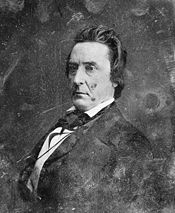 Senate President pro tempore David R. Atchison 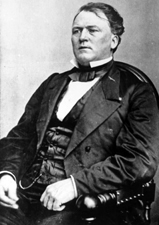 Senate President pro tempore Jesse D. Bright |
House of Representatives
The names of members of the House of Representatives are preceded by their district numbers.
|
| 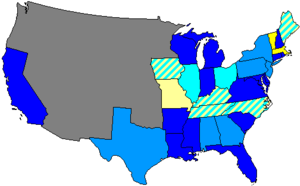
 House Speaker Linn Boyd | |||||||||||
Changes in membership
The count below reflects changes from the beginning of the first session of this Congress.
Senate
- replacements: 7
Democrats (D): no net change
Whigs (W): 2 seat net loss
Free Soilers (FS): 2 seat net gain
- deaths: 2
- resignations: 4
- interim appointments: 1
- Total seats with changes: 13
| State (class) | Vacator | Reason for change | Successor | Date of successor's formal installation |
|---|---|---|---|---|
Rhode Island (2) | Vacant | Failure to elect. Successor was elected July 20, 1853. | Philip Allen (D) | July 20, 1853 |
Alabama (2) | Vacant | Failure to elect. Successor elected November 29, 1853. | Clement C. Clay (D) | November 29, 1853 |
Mississippi (2) | Vacant | Failure to elect. Successor elected January 7, 1854. | Albert G. Brown (D) | January 7, 1854 |
Maine (2) | Vacant | Failure to elect. Successor was elected February 10, 1854. | William P. Fessenden (W) | February 10, 1854 |
North Carolina (2) | Vacant | Failure to elect. Successor was elected December 6, 1854. | David Reid (D) | December 6, 1854 |
Arkansas (3) | Solon Borland (D) | Resigned April 11, 1853, after being appointed U.S. Minister to Nicaragua and other Central American Republics. Successor appointed July 6, 1853. | Robert W. Johnson (D) | July 6, 1853 |
Louisiana (3) | Pierre Soulé (D) | Resigned April 11, 1853, after being appointed U.S. Minister to Spain. Successor elected December 5, 1853. | John Slidell (D) | December 5, 1853 |
New Hampshire (2) | Charles G. Atherton (D) | Died November 15, 1853. | Jared W. Williams (D) | November 29, 1853 |
Vermont (3) | Samuel S. Phelps (W) | Senate declared not entitled to seat March 16, 1854. Successor elected October 14, 1854. | Lawrence Brainerd (FS) | October 14, 1854 |
Connecticut (3) | Truman Smith (W) | Resigned May 24, 1854. Successor was elected May 24, 1854. | Francis Gillette (FS) | May 24, 1854 |
Massachusetts (2) | Edward Everett (W) | Resigned June 1, 1854 Successor was appointed to serve until a new successor was elected. | Julius Rockwell (W) | June 3, 1854 |
New Hampshire (2) | Jared W. Williams (D) | Resigned August 4, 1854. | Vacant | Not filled this term |
New Hampshire (3) | Moses Norris, Jr. (D) | Died January 11, 1855. Successor appointed January 16, 1855, to finish the term. | John S. Wells (D) | January 16, 1855 |
Massachusetts (2) | Julius Rockwell (W) | Successor elected January 31, 1855. | Henry Wilson (FS) | January 31, 1855 |
Iowa (3) | Augustus C. Dodge (D) | Resigned February 22, 1855, after being appointed U.S. Minister to Spain. | Vacant | Not filled this term |
House of Representatives
- replacements: 7
Democrats (D): 2 seat net loss
Whigs (W): 3 seat net gain
Free Soilers (FS): 1 seat net loss
- deaths: 4
- resignations: 4
- Total seats with changes: 8
| District | Vacator | Reason for change | Successor | Date of successor's formal installation |
|---|---|---|---|---|
Washington Territory at-large | Vacant | New seat established after Washington became a territory near the end of previous Congress. Seat was vacant until April 12, 1854. | Columbia Lancaster (D) | Seated April 12, 1854 |
New York 29th | Azariah Boody (W) | Resigned on October 13, 1853 | Davis Carpenter (W) | Seated November 8, 1853 |
Tennessee 1st | Brookins Campbell (D) | Died December 25, 1853 | Nathaniel G. Taylor (W) | Seated March 30, 1854 |
Pennsylvania 8th | Henry A. Muhlenberg (D) | Died January 9, 1854 | J. Glancy Jones (D) | Seated February 4, 1854 |
Massachusetts 1st | Zeno Scudder (W) | Resigned March 4, 1854 | Thomas D. Eliot (W) | Seated April 17, 1854 |
Kansas Territory at-large | New seat | New seat established after Kansas became a territory May 30, 1854. Seat was vacant until December 20, 1854. | John W. Whitfield (D) | Seated December 20, 1854 |
Nebraska Territory at-large | New seat | New seat established after Nebraska became a territory May 30, 1854. Seat was vacant until January 5, 1855. | Napoleon B. Giddings (D) | Seated December 5, 1855 |
Virginia 11th | John F. Snodgrass (D) | Died June 5, 1854 | Charles S. Lewis (D) | Seated December 4, 1854 |
New York 12th | Gilbert Dean (D) | Resigned July 3, 1854, after being appointed justice of the Supreme Court of New York | Isaac Teller (W) | Seated November 7, 1854 |
New York 22nd | Gerrit Smith (FS) | Resigned August 7, 1854 | Henry C. Goodwin (W) | Seated November 7, 1854 |
Kentucky 3rd | Presley Ewing (W) | Died September 27, 1854 | Francis Bristow (W) | Seated December 4, 1854 |
Committees
Lists of committees and their party leaders.
Senate
- Agriculture
American Association for the Promotion of Science (Select)
Atmospheric Telegraph Between Washington and Baltimore (Select)- Audit and Control the Contingent Expenses of the Senate
- Claims
- Commerce
Distributing Public Revenue Among the States (Select)- District of Columbia
- Finance
- Foreign Relations
French Spoilations (Select)- Indian Affairs
- Judiciary
Loss of Original Papers of Mark and Richard Bean (Select)- Manufactures
Mexican Claims Commission (Select)- Military Affairs
- Militia
- Naval Affairs
Ordnance and War Ships (Select)
Pacific Railroad (Select)- Patents and the Patent Office
- Pensions
- Post Office and Post Roads
- Printing
Private Claims Commission (Select)- Private Land Claims
Protection of Life and Health in Passenger Ships (Select)- Public Buildings and Grounds
- Public Lands
- Retrenchment
- Revolutionary Claims
- Roads and Canals
Sickness on Emigrant Ships (Select)
Tariff Regulation (Select)- Territories
- Whole
House of Representatives
- Accounts
- Agriculture
- Claims
- Commerce
- District of Columbia
- Elections
- Engraving
- Expenditures in the Navy Department
- Expenditures in the Post Office Department
- Expenditures in the State Department
- Expenditures in the Treasury Department
- Expenditures in the War Department
- Expenditures on Public Buildings
- Foreign Affairs
- Indian Affairs
- Invalid Pensions
- Manufactures
- Mileage
- Military Affairs
- Militia
- Naval Affairs
- Patents
- Post Office and Post Roads
- Public Buildings and Grounds
- Public Expenditures
- Public Lands
- Revisal and Unfinished Business
- Revolutionary Claims
- Roads and Canals
Rules (Select)- Standards of Official Conduct
- Territories
- Ways and Means
- Whole
Joint committees
- Amending the Constitution on Presidential and Vice Presidential Elections
- Enrolled Bills
- San Francisco Disaster
Caucuses
Democratic (House)
Democratic (Senate)
Employees
Architect of the Capitol: Thomas U. Walter
Librarian of Congress: John Silva Meehan
Senate
Chaplain: Clement M. Butler (Episcopalian)
Henry Slicer (Methodist), elected December 7, 1853
Secretary: Asbury Dickens of North Carolina
Sergeant at Arms: Robert Beale
Dunning R. McNair, elected March 17, 1853
House of Representatives
Chaplain: William H. Milburn (Methodist)
Clerk: John W. Forney
Doorkeeper: Zadock W. McKnew
Postmaster: John M. Johnson
Reading Clerks: [Data unknown/missing.]
Sergeant at Arms: Adam J. Glossbrenner
See also
United States elections, 1852 (elections leading to this Congress)- United States presidential election, 1852
- United States Senate elections, 1852 and 1853
- United States House of Representatives elections, 1852
United States elections, 1854 (elections during this Congress, leading to the next Congress)- United States Senate elections, 1854 and 1855
- United States House of Representatives elections, 1854
References
Martis, Kenneth C. (1989). The Historical Atlas of Political Parties in the United States Congress. New York: Macmillan Publishing Company..mw-parser-output cite.citationfont-style:inherit.mw-parser-output .citation qquotes:"""""""'""'".mw-parser-output .citation .cs1-lock-free abackground:url("//upload.wikimedia.org/wikipedia/commons/thumb/6/65/Lock-green.svg/9px-Lock-green.svg.png")no-repeat;background-position:right .1em center.mw-parser-output .citation .cs1-lock-limited a,.mw-parser-output .citation .cs1-lock-registration abackground:url("//upload.wikimedia.org/wikipedia/commons/thumb/d/d6/Lock-gray-alt-2.svg/9px-Lock-gray-alt-2.svg.png")no-repeat;background-position:right .1em center.mw-parser-output .citation .cs1-lock-subscription abackground:url("//upload.wikimedia.org/wikipedia/commons/thumb/a/aa/Lock-red-alt-2.svg/9px-Lock-red-alt-2.svg.png")no-repeat;background-position:right .1em center.mw-parser-output .cs1-subscription,.mw-parser-output .cs1-registrationcolor:#555.mw-parser-output .cs1-subscription span,.mw-parser-output .cs1-registration spanborder-bottom:1px dotted;cursor:help.mw-parser-output .cs1-ws-icon abackground:url("//upload.wikimedia.org/wikipedia/commons/thumb/4/4c/Wikisource-logo.svg/12px-Wikisource-logo.svg.png")no-repeat;background-position:right .1em center.mw-parser-output code.cs1-codecolor:inherit;background:inherit;border:inherit;padding:inherit.mw-parser-output .cs1-hidden-errordisplay:none;font-size:100%.mw-parser-output .cs1-visible-errorfont-size:100%.mw-parser-output .cs1-maintdisplay:none;color:#33aa33;margin-left:0.3em.mw-parser-output .cs1-subscription,.mw-parser-output .cs1-registration,.mw-parser-output .cs1-formatfont-size:95%.mw-parser-output .cs1-kern-left,.mw-parser-output .cs1-kern-wl-leftpadding-left:0.2em.mw-parser-output .cs1-kern-right,.mw-parser-output .cs1-kern-wl-rightpadding-right:0.2em
Martis, Kenneth C. (1982). The Historical Atlas of United States Congressional Districts. New York: Macmillan Publishing Company.
External links
- Statutes at Large, 1789–1875
- Senate Journal, First Forty-three Sessions of Congress
- House Journal, First Forty-three Sessions of Congress
- Biographical Directory of the U.S. Congress
- U.S. House of Representatives: House History
- U.S. Senate: Statistics and Lists
Congressional Directory for the 33rd Congress, 2nd Session.


